Image AIProduct ShotsIntermediate60 minSaves 1 hour

Modern Heritage Wine Label Concepts for Reserve Release

Packaging designers can quickly visualize label concepts for small vineyards launching their first premium reserve wine, balancing contemporary aesthetics with established heritage.

Generate diverse wine label design concepts tailored for a small vineyard's inaugural reserve bottling. Explore modern aesthetics blended with heritage elements, considering material, print, color, and on-shelf impact to inform initial design directions efficiently.

READY-TO-USE PROMPT

Copy Prompt

prompt.txt
Role: Act as a senior packaging designer specializing in premium beverage branding and visual identity. Your expertise lies in translating brand values into tangible, shelf-ready designs.

Context: You are tasked with developing initial label design concepts for {{vineyard_name}}'s first reserve wine. The objective is to create a label that communicates both modern sophistication and a deep respect for winemaking heritage, suitable for a premium product. The target audience appreciates craft, quality, and understated elegance. The wine is a {{wine_variety}}.

Task: Generate 3-5 distinct wine label design concepts. Each concept must be presented as a detailed visual description suitable for an image generation model, ensuring material, print, colorway, and on-shelf context are clearly defined. Focus on designs that blend contemporary aesthetics with subtle heritage cues, avoiding overly traditional or rustic imagery. The desired aesthetic is {{desired_aesthetic_keywords}}.

Constraints:
*   Each concept must include specific details on: label shape, primary material, print technique, color palette, key graphic elements, and a brief description of its perceived on-shelf impact.
*   The designs should convey premium quality without being ostentatious.
*   Prioritize legibility and clear brand communication.
*   Avoid designs that appear cheap, dated, or overly ornate.
*   Consider a standard 750ml dark glass Bordeaux or Burgundy bottle as the canvas.
*   Ensure that any heritage elements are subtly integrated, not dominating the modern feel.

Output:
For each of the 3-5 concepts, provide the following structure:

1.  **Concept Title:** A concise, evocative name (e.g., "The Modern Heirloom," "Terroir's Whisper").
2.  **Image Prompt Description:** A detailed, single-paragraph textual description for an image generation model. This description should cover:
    *   **Bottle Form:** (e.g., "a dark green 750ml Bordeaux wine bottle")
    *   **Label Configuration:** (e.g., "a single rectangular front label with a small neck label," "a full-wrap minimalist label," "an irregularly die-cut label")
    *   **Primary Material:** (e.g., "heavy cream laid paper," "clear matte film," "brushed aluminum foil stock")
    *   **Print Technique & Finish:** (e.g., "debossed typography with spot UV varnish accents," "letterpress printing with metallic ink details," "digital print with a soft-touch laminate")
    *   **Color Palette:** (e.g., "muted earth tones with a single metallic accent," "monochromatic deep charcoal and silver," "soft pastels with a bold typographic element")
    *   **Key Graphic Elements:** (e.g., "an abstract representation of rolling hills," "a minimalist line drawing of a grape leaf," "a subtly integrated geometric pattern referencing vineyard rows," "custom serif typography for the brand name")
    *   **Overall Mood/Tone:** (e.g., "understated luxury and timelessness," "crisp modernity with a nod to tradition," "organic sophistication")
    *   **On-Shelf Impact:** A brief note on how this design would stand out and its perceived value.
    *   **Negative Prompts:** List specific elements to exclude (e.g., "cluttered, busy, cheap, cartoonish, childish, blurry, low-resolution, stock imagery, dated, rustic, overly traditional, garish colors, poor legibility, jagged edges, uneven printing, pixelated").

Ensure the descriptions are vivid and precise, allowing the image model to produce compelling visual representations.
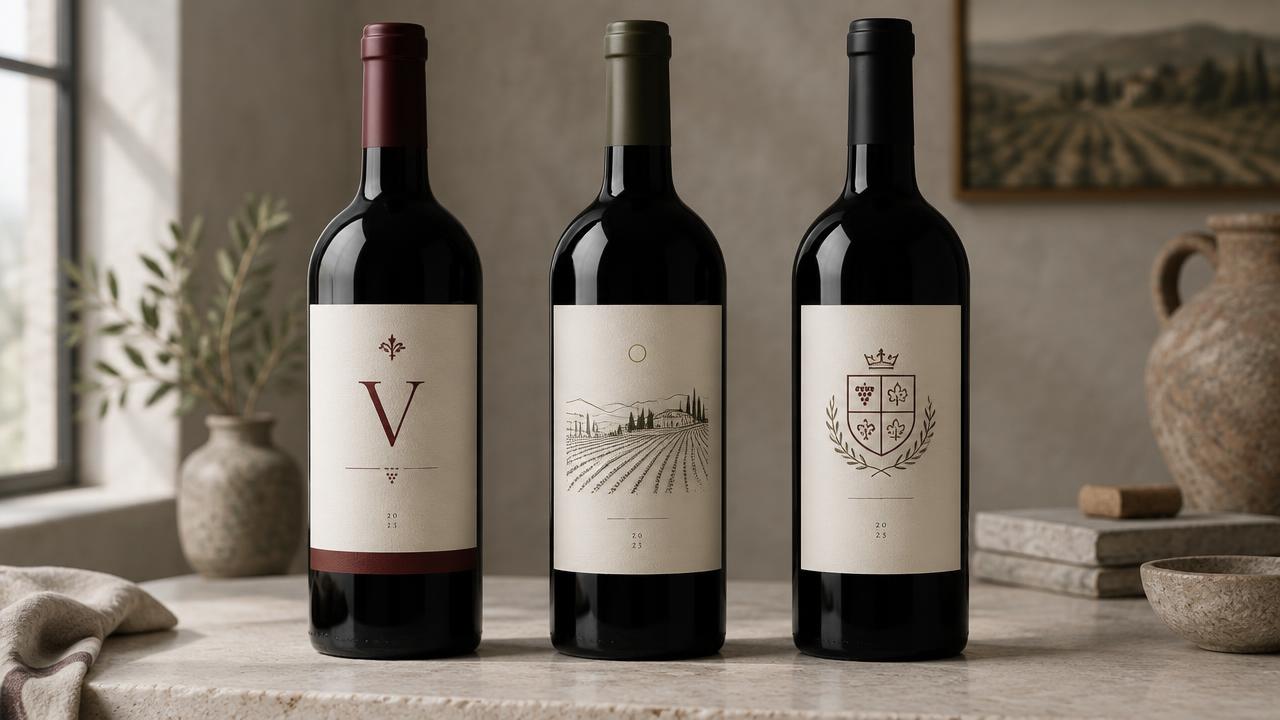
Estimated results

DifficultyIntermediate
Setup time60 min
Time saved1 hour
Best modelsMidjourney, Flux
Best audienceBeverage, Packaging

Editor's note

Why this prompt matters

Small vineyards launching their first premium reserve wine often face the challenge of creating a label that stands out. The design must convey both contemporary elegance and a deep respect for winemaking tradition, all while adhering to budget and timeline realities. This is particularly true for smaller operations where every design decision impacts market perception and sales.

This workflow is for packaging designers and vineyard owners seeking to rapidly explore initial label concepts. It streamlines the ideation phase, allowing for quick visualization of diverse design directions that balance modern aesthetics with subtle heritage cues. Rather than spending extensive time on manual mock-ups for early concepts, designers can generate a range of detailed visual descriptions ready for image AI.

The approach is valuable when presenting preliminary concepts to clients, refining a design brief, or simply brainstorming within a team. It helps ensure that the generated ideas are not only visually compelling but also grounded in specific material, print, and on-shelf considerations, providing a more tangible starting point for further development.

Anatomy

Prompt engineering breakdown

Role

Act as a senior packaging designer specializing in premium beverage branding and visual identity.

Context

Developing initial label design concepts for a small vineyard's first reserve wine. The objective is to create a label that communicates both modern sophistication and a deep respect for winemaking heritage, suitable for a premium product. The target audience appreciates craft, quality, and understated elegance.

Goal

Generate 3-5 distinct wine label design concepts. Each concept must be presented as a detailed visual description suitable for an image generation model, ensuring material, print, colorway, and on-shelf context are clearly defined.

Constraints

Each concept must include specific details on: label shape, primary material, print technique, color palette, key graphic elements, and a brief description of its perceived on-shelf impact. Designs should convey premium quality without being ostentatious, prioritize legibility, and avoid appearing cheap, dated, or overly ornate. Consider a standard 750ml dark glass Bordeaux or Burgundy bottle, and integrate heritage elements subtly.

Output format

For each of the 3-5 concepts, provide a Concept Title, a detailed Image Prompt Description (covering bottle form, label configuration, primary material, print technique, color palette, key graphic elements, overall mood/tone, on-shelf impact), and Negative Prompts.

Why this structure works

This prompt employs role priming to establish the AI's persona as an expert packaging designer, ensuring the output aligns with industry standards. Explicit constraints guide the AI to focus on specific design elements like materials and print techniques, preventing generic results. The structured output format guarantees comprehensive, actionable descriptions suitable for direct input into image generation models.

Pick your version

Prompt variations

BeginnerWorks with any model

For users new to prompt engineering or image generation, needing simpler instructions and focusing on core design elements without extensive technical detail.

prompt.txt
Role: You are a label designer.

Context: Create label ideas for {{vineyard_name}}'s new special wine. It needs to look modern but also show it's a traditional wine. The wine is a {{wine_variety}}.

Task: Give me 3 different label ideas. For each idea, describe what it looks like so I can use it in an image maker. Tell me about the label's shape, what it's made of, how it's printed, the colors, and any pictures or words on it. Also, say how it would look on a store shelf. Keep it elegant and not too old-fashioned.

Constraints: Each idea must include: label shape, material, print style, colors, main picture/text, and how it looks on a shelf. Avoid cheap or too busy designs. Use a regular wine bottle.

Output: For each idea, give a title, then a paragraph describing the bottle, label material, print, colors, key graphics, overall feeling, and on-shelf look. Also, list things to avoid (e.g., "ugly, messy, blurry").
ProfessionalBest with midjourney

When detailed, high-fidelity concepts are required for a discerning client or internal review, matching the depth of the original prompt.

prompt.txt
Role: Serve as a senior packaging designer, specializing in premium beverage branding.

Context: Develop initial label concepts for {{vineyard_name}}'s inaugural reserve wine. The design must project modern sophistication while honoring winemaking heritage, targeting consumers who value craft and elegance. The wine is a {{wine_variety}}.

Task: Generate 3-5 distinct label concepts. Present each as a detailed visual prompt for an image generation model, specifying label configuration, primary material, print technique, color palette, and on-shelf context. Blend contemporary aesthetics with subtle heritage elements, avoiding overtly rustic or traditional styles. The desired aesthetic is {{desired_aesthetic_keywords}}.

Constraints:
*   Each concept must detail: label shape, material, print technique, color palette, key graphic elements, and a note on on-shelf impact.
*   Convey premium quality without ostentation.
*   Ensure legibility and clear brand communication.
*   Avoid cheap, dated, or overly ornate designs.
*   Assume a standard 750ml dark glass Bordeaux or Burgundy bottle.
*   Integrate heritage subtly, not dominantly.

Output: For each concept, provide: 1. Concept Title. 2. Image Prompt Description covering Bottle Form, Label Configuration, Primary Material, Print Technique & Finish, Color Palette, Key Graphic Elements, Overall Mood/Tone, On-Shelf Impact. 3. Negative Prompts (e.g., "cluttered, blurry, low-resolution, dated, garish colors, poor legibility").
Short VersionBest with flux

For quick concept generation or when iterating rapidly on core ideas without extensive detail, suitable for quick visual exploration.

prompt.txt
Act as a packaging designer for {{vineyard_name}}'s new reserve {{wine_variety}}. Generate 3 modern, heritage-aware label concepts for an image AI. For each, describe the label shape, material, print, color palette, key graphics, and on-shelf impact for a 750ml bottle, aiming for a {{desired_aesthetic_keywords}} look. Avoid anything cheap, rustic, or overly traditional. Provide a concise image prompt and negative keywords for each concept. Focus on premium feel and clear communication.
EnterpriseBest with midjourney

For large organizations where brand consistency, regulatory adherence, and stakeholder approval are critical, requiring comprehensive risk assessment and compliance language.

prompt.txt
Role: Function as a lead packaging architect, ensuring brand integrity, regulatory compliance, and market differentiation for premium beverage lines.

Context: Develop critically vetted label design concepts for {{vineyard_name}}'s flagship reserve wine. Designs must balance modern appeal with established brand heritage, resonate with a discerning clientele, and align with all internal brand guidelines and external regulatory requirements. The wine is a {{wine_variety}}.

Task: Propose 3-5 comprehensive label design concepts, each articulated as a detailed image generation prompt. These concepts must incorporate material specifications, print methodologies, color standardization, and an assessment of on-shelf competitive differentiation. Emphasize designs that strategically integrate contemporary trends with heritage cues, undergoing a preliminary risk assessment for brand dilution or misinterpretation. The desired aesthetic is {{desired_aesthetic_keywords}}.

Constraints:
*   Each concept must explicitly detail: label shape, primary material, print technique, CMYK/Pantone references (where applicable), key graphic elements, and a preliminary assessment of on-shelf competitive advantage and brand alignment.
*   Designs must adhere to {{brand_guidelines_document}} and all relevant {{regulatory_standards}} for wine labeling.
*   Prioritize clear communication and avoid any visual ambiguity that could lead to misinterpretation or compliance issues.
*   Mitigate risks of designs appearing generic, dated, or inappropriate for a premium segment.
*   Assume a standard 750ml dark glass bottle, suitable for global distribution.
*   Heritage integration must be subtle, reinforcing brand story without compromising modern market appeal or causing legal issues.

Output: For each concept, provide: 1. Concept Title. 2. Image Prompt Description (detailed for AI, including all technical and aesthetic specifications). 3. Compliance and Risk Notes (e.g., "Potential compliance issue with font size for alcohol content," "Strong market differentiation but requires stakeholder buy-in on color palette"). 4. Negative Prompts (e.g., "non-compliant text, brand guideline deviation, low-resolution, visually confusing, generic, off-brand colors, excessive embellishment, regulatory non-conformance").

What you'll get

Expected output

  1. Concept Title: Terroir's Modern Veil
  2. Image Prompt Description: A dark green 750ml Bordeaux wine bottle featuring a single, vertically oriented rectangular front label that wraps slightly around the bottle's curve. The primary material is a heavy, uncoated cream cotton paper with a subtle texture. Print technique involves blind debossing for the vineyard name, paired with letterpress printing in a deep charcoal ink for the wine variety and region. The color palette is restricted to cream, charcoal, and a single, fine line of muted copper foil. Key graphic elements include bespoke, elongated serif typography for "Stonewall Estate" and a minimalist, abstract line drawing subtly representing the layered soil strata of a vineyard, integrated near the bottom edge. The overall mood is one of understated luxury and organic sophistication. On-shelf impact: This design communicates refined quality and a connection to the land through its tactile materials and subtle graphical elements, standing out with its quiet elegance amidst more overt designs.

Negative Prompts: cluttered, busy, cheap, cartoonish, childish, blurry, low-resolution, stock imagery, dated, rustic, overly traditional, garish colors, poor legibility, jagged edges, uneven printing, pixelated.

---

  1. Concept Title: The Architect's Vintage
  2. Image Prompt Description: A standard dark glass 750ml Burgundy wine bottle with a clean, full-wrap minimalist label. The primary material is a smooth, clear matte film that allows the bottle's color to show through, creating depth. Print technique uses opaque white ink for primary text and a subtle silver metallic ink for a geometric pattern, finished with a selective gloss varnish over the vineyard name. The color palette is monochromatic, focusing on the dark bottle glass, crisp white, and a cool silver accent. Key graphic elements include a custom sans-serif typeface with generous kerning for the brand name, and a subtly integrated, repeating geometric pattern resembling vineyard rows from an aerial perspective. The overall mood is crisp modernity with a clear nod to tradition through structural elegance. On-shelf impact: The design projects a contemporary, architectural feel, conveying precision and high quality through its restrained use of color and precise graphics, appealing to those who appreciate modern design.

Negative Prompts: cluttered, busy, cheap, cartoonish, childish, blurry, low-resolution, stock imagery, dated, rustic, overly traditional, garish colors, poor legibility, jagged edges, uneven printing, pixelated.

Under the hood

Why this prompt works

This prompt produces effective image generation outputs due to its layered application of specific engineering techniques. First, role priming establishes the persona of a "senior packaging designer specializing in premium beverage branding." This directs the model to adopt an expert perspective, informing the sophistication and detail in the generated concepts.

The explicit constraints are crucial, guiding the model on what to include (e.g., label shape, material, print technique, color palette, on-shelf impact) and what to avoid (e.g., "cheap, dated, overly ornate"). These boundaries prevent generic or irrelevant outputs, ensuring the concepts are practical and align with the desired premium aesthetic.

Furthermore, the structured output requirement is key. By demanding a specific format for each concept—including a title, a detailed image prompt description broken into sub-elements, and negative prompts—the model is forced to organize its response logically. This structure ensures comprehensive descriptions that cover all critical visual and material aspects, providing highly actionable input for image generation models. The negative prompts explicitly refine the output, reducing unwanted visual noise and focusing on the desired clean, modern heritage aesthetic. This comprehensive approach yields distinct, high-fidelity design concepts rather than vague suggestions.

Model fit

Best AI models for this prompt

Midjourney

Midjourney excels at generating high-fidelity, aesthetically pleasing images with strong artistic direction. Its ability to interpret nuanced stylistic descriptions and render sophisticated textures makes it suitable for detailed label concepts, especially when specifying print techniques and material finishes. However, achieving precise text legibility or exact logo placement can require multiple iterations and inpainting. See the full Midjourney hub for deeper guidance.

Flux

Flux offers strong capabilities in generating diverse visual styles and adapting to complex textual prompts, making it effective for exploring a broad range of design directions quickly. It handles material and lighting well, contributing to realistic mockups. While generally good, highly intricate details or very specific graphic elements might require careful prompt engineering to achieve consistency. See the full Flux hub for deeper guidance.

When to use

  • When exploring initial design directions for a new premium wine label, especially for a first reserve release.
  • When needing diverse label concepts that balance contemporary aesthetics with subtle traditional cues.
  • When briefing an external design agency or internal team with clear visual starting points.
  • When aiming for shelf impact that communicates understated elegance and perceived high value.
  • When seeking inspiration for specific material, print finish, and colorway combinations early in the design process.

When not to use

  • When final production-ready label files are required; this workflow is for conceptual exploration only.
  • When the brand aesthetic is strictly traditional, overtly rustic, or explicitly playful.
  • When the primary focus is on regulatory text, ingredient lists, or other detailed copy elements.
  • When only minor adjustments to an existing label design are needed, rather than new concepts.
  • When an exact, photo-realistic rendering of a specific material is critical without further iteration.

Get more from it

Pro tips

  • 1

    Vary the {{desired_aesthetic_keywords}} input extensively to explore a wider spectrum of modern-heritage blends, preventing repetitive outputs.

  • 2

    Experiment with different bottle forms (e.g., Bordeaux, Burgundy, custom) in your descriptions to see how label designs adapt, avoiding a narrow visual scope.

  • 3

    Be highly precise with print techniques and material finishes (e.g., 'silk screen varnish,' 'cotton stock') to guide the AI toward specific tactile qualities, preventing generic renderings.

  • 4

    Adjust the number and complexity of graphic elements specified for each concept to control visual busyness and maintain clarity.

  • 5

    Use distinct color palettes for each concept to ensure clear visual differentiation among the generated options.

  • 6

    Refine your negative prompts based on initial outputs to quickly eliminate undesirable visual traits, improving iteration speed.

Don't ship this

Common mistakes

  • Overly vague descriptions of heritage cues, leading to generic or non-specific traditional elements.

    Fix — Specify 'subtle debossed vineyard map' or 'abstracted historical emblem' to guide the AI more effectively toward the desired heritage feel.

  • Neglecting to mention material texture or finish beyond basic type, resulting in flat, uninspired concepts.

    Fix — Include terms like 'textured linen paper,' 'smooth recycled glass stock,' or 'soft-touch laminate' for a more tactile and premium concept.

  • Reusing similar color palettes across multiple concepts, which makes the generated options indistinguishable.

    Fix — Intentionally vary palettes (e.g., 'deep forest green with copper accents,' 'monochromatic charcoal and frosted white') for distinct visual choices.

  • Omitting on-shelf context, which leaves the concept's market impact undefined.

    Fix — Add a phrase like 'stands out subtly on a dark shelf' or 'evokes premium feel next to competitors' to define its perceived market presence.

  • Using generic negative prompts that don't address specific unwanted elements observed in early runs.

    Fix — Tailor negatives to specific issues like 'cartoonish grapes,' 'overly distressed textures,' or 'poor kerning' to quickly refine outputs.

  • Not specifying the brand name typography style, leading to inconsistent or inappropriate font choices.

    Fix — Add 'custom sans-serif logotype' or 'elegant condensed serif font' to influence the text appearance and align with brand identity.

People also ask

Frequently asked questions

Q.Can I use this workflow for other beverage types, like craft beer or spirits?

Yes, the core structure for material, print, and on-shelf context is adaptable. Adjust the 'wine_variety' and 'desired_aesthetic_keywords' to reflect the specific beverage and its target aesthetic. Focus on packaging cues relevant to that category.

Q.How many concepts should I request from the model for optimal results?

Starting with 3-5 concepts as suggested typically provides a good balance of variety without overwhelming the ideation process. If initial outputs are promising, you can request more focused iterations.

Q.What if the AI generates text on the label that isn't legible or accurate?

AI image models often struggle with precise text. Use negatives like 'poor legibility, garbled text' and emphasize 'clear brand communication' in the prompt. Remember, these are concepts; text will be finalized in graphic design software.

Q.Will this workflow generate a fully finished, print-ready label design?

No, this workflow is designed to generate conceptual visuals for design exploration. It's an ideation tool, providing strong visual directions, not a final production file generator. Designers use these as a starting point.

Q.How specific should I be with the 'desired_aesthetic_keywords' input?

Be as specific as possible. Instead of 'modern,' try 'minimalist modern, Nordic design influence.' Instead of 'heritage,' try 'subtle Art Deco heritage, classic engraving style.' This helps narrow the AI's interpretation and improves relevance.

Q.Can I specify a bottle color or type other than a dark glass Bordeaux/Burgundy?

Absolutely. You can change 'dark glass Bordeaux or Burgundy bottle' to 'frosted clear glass bottle,' 'amber glass bottle,' or even a custom bottle shape to explore different base canvases for your labels.

Version 1.0Last reviewed July 20, 2026
Reviewed by PromptInFlow Editorial Team