Image AIBrandingAdvanced90 minSaves 2+ hours

Podcast Brand Identity Exploration: Interview Show Visuals

For podcast operators and indie studios, generate comprehensive brand identity concepts including logo ideas, color palettes, and typography pairings, to establish a distinct visual presence.

This prompt guides image AI to generate initial brand identity concepts for an interview podcast. It covers logo ideation, color palettes, typography vibes, and sample compositions, streamlining the visual exploration phase for brand designers and podcast creators.

READY-TO-USE PROMPT

Copy Prompt

prompt.txt
Role: Brand Identity Designer specializing in audio media.

Context: Developing the visual identity for an interview-style podcast named "{{podcast_name}}". The show focuses on {{podcast_niche}}. The target audience is {{target_audience_description}}. The host's persona is {{host_persona}}.

Task: Generate a mini brand-mood specification that includes a primary logo concept, a color palette, typography suggestions, and three distinct sample compositions. Also include a list of negative prompts.

Constraints:
* The output must reflect a system-thinking, identity-first approach.
* Focus on visual elements suitable for podcast cover art, social media, and basic website branding.
* Avoid overly complex or illustrative styles; aim for modern, clean, and adaptable visuals.
* The logo concept should be abstract or typographic, not a literal representation of an interview.
* Color palette should include 3-5 primary and secondary colors with HEX codes or clear descriptions.
* Typography vibe should suggest 2-3 font styles (e.g., "modern sans-serif," "classic serif for headlines").
* Sample compositions should illustrate potential applications of the brand elements.
* Negative prompts should address common undesirable outputs for branding.

Output: A structured response in the following format:

*   **Podcast Name**: {{podcast_name}}
*   **Podcast Niche**: {{podcast_niche}}
*   **Host Persona**: {{host_persona}}
*   **Target Audience**: {{target_audience_description}}
*   **Overall Brand Vibe**: [Short descriptive phrase]
*   **Logo Concept**:
    *   [Description of abstract or typographic logo idea, including key visual elements and style. Provide an image prompt for this logo.]
*   **Color Palette**:
    *   [Primary Color Name]: [HEX Code/Description]
    *   [Secondary Color Name]: [HEX Code/Description]
    *   [Accent Color Name]: [HEX Code/Description]
    *   [Optional: Additional colors]
*   **Typography Vibe**:
    *   [Headline Font Style Description]
    *   [Body Text Font Style Description]
    *   [Accent Font Style Description (if applicable)]
*   **Texture/Materiality (if applicable)**:
    *   [Brief description of any recurring textures or materials, e.g., "subtle paper grain," "smooth gradients," "matte finish."]
*   **Sample Composition 1: Podcast Cover Art**:
    *   [Description of visual composition for cover art, incorporating logo, colors, type. Provide an image prompt for this composition.]
*   **Sample Composition 2: Social Media Banner**:
    *   [Description of visual composition for a social media banner. Provide an image prompt for this composition.]
*   **Sample Composition 3: Web Header**:
    *   [Description of visual composition for a website header. Provide an image prompt for this composition.]
*   **Negative Prompts**:
    *   [List of comma-separated terms to exclude, e.g., "cluttered," "cartoonish," "photorealistic," "busy," "disjointed," "text overlay," "watermark," "people," "microphones," "headphones."]

Estimated results

DifficultyAdvanced
Setup time90 min
Time saved2+ hours
Best modelsMidjourney, Flux
Best audienceMedia, Design

Editor's note

Why this prompt matters

Creating a distinct visual identity for an interview podcast can be challenging. Many shows struggle with generic visuals that fail to convey their unique tone or attract their ideal audience. This often leads to a fragmented brand presence across different platforms, making it harder for new listeners to recognize and connect with the content.

This workflow is designed for podcast operators, independent studios, and content creators who need a structured approach to developing initial brand concepts. It helps in articulating the core visual elements of a podcast, from logo ideas to color palettes and typography, before committing to extensive design work. By defining these foundational elements early, teams can ensure visual consistency and resonance with their target listeners.

Reach for this workflow when you are in the conceptual stage of a new podcast, considering a brand refresh, or need to present a cohesive visual direction to stakeholders. It provides a solid starting point for visual designers or a clear brief for a design agency, ensuring that the visual brand aligns with the podcast's thematic focus and host persona.

Anatomy

Prompt engineering breakdown

Role

Brand Identity Designer specializing in audio media.

Context

Developing the visual identity for an interview-style podcast named "{{podcast_name}}". The show focuses on {{podcast_niche}}. The target audience is {{target_audience_description}}. The host's persona is {{host_persona}}.

Goal

Generate a mini brand-mood specification that includes a primary logo concept, a color palette, typography suggestions, and three distinct sample compositions. Also include a list of negative prompts.

Constraints

The output must reflect a system-thinking, identity-first approach, focusing on modern, clean, and adaptable visuals suitable for podcast cover art, social media, and basic website branding. Avoid overly complex or illustrative styles. The logo concept should be abstract or typographic. Color palette must include 3-5 colors with HEX codes or clear descriptions. Typography vibe should suggest 2-3 font styles. Sample compositions should illustrate potential applications. Negative prompts should address common undesirable outputs for branding.

Output format

A structured response detailing the Podcast Name, Niche, Host Persona, Target Audience, Overall Brand Vibe, Logo Concept (with an image prompt), Color Palette (with HEX/description), Typography Vibe, optional Texture/Materiality, three distinct Sample Compositions (each with an image prompt), and a list of Negative Prompts.

Why this structure works

Role priming establishes the AI as an expert, ensuring the generated branding advice is relevant and professional. Explicit constraints guide the aesthetic direction and technical requirements, preventing off-topic or unusable outputs. The structured output format ensures all necessary brand elements are covered comprehensively and presented in a clear, actionable manner, which is crucial for subsequent image generation.

Pick your version

Prompt variations

BeginnerWorks with any model

For initial visual ideas or when the user is new to brand identity concepts and needs simplified inputs.

prompt.txt
As a Brand Designer, propose a visual concept for a podcast called '{{podcast_name}}' about '{{podcast_niche}}'. The show needs a clean, modern look. Suggest a simple logo idea, a few main colors (e.g., 'blue', 'green'), and a general font style (e.g., 'modern sans-serif'). Show one example of how this might look on a podcast cover. Provide a short list of things to avoid in the images. Focus on clear, adaptable visuals suitable for online use. The logo should not be a literal drawing of an interview. Give specific image prompt ideas for the logo and cover art. List negative terms to exclude.
ProfessionalBest with midjourney

When a detailed and comprehensive brand mood board specification is required, aligning with industry standards for visual identity development.

prompt.txt
Role: Brand Identity Designer specializing in audio media.

Context: Developing the visual identity for an interview-style podcast named "{{podcast_name}}". The show focuses on {{podcast_niche}}. The target audience is {{target_audience_description}}. The host's persona is {{host_persona}}.

Task: Generate a mini brand-mood specification that includes a primary logo concept, a color palette, typography suggestions, and three distinct sample compositions. Also include a list of negative prompts.

Constraints:
* The output must reflect a system-thinking, identity-first approach.
* Focus on visual elements suitable for podcast cover art, social media, and basic website branding.
* Avoid overly complex or illustrative styles; aim for modern, clean, and adaptable visuals.
* The logo concept should be abstract or typographic, not a literal representation of an interview.
* Color palette should include 3-5 primary and secondary colors with HEX codes or clear descriptions.
* Typography vibe should suggest 2-3 font styles (e.g., "modern sans-serif," "classic serif for headlines").
* Sample compositions should illustrate potential applications of the brand elements.
* Negative prompts should address common undesirable outputs for branding.

Output: A structured response in the following format:

*   **Podcast Name**: {{podcast_name}}
*   **Podcast Niche**: {{podcast_niche}}
*   **Host Persona**: {{host_persona}}
*   **Target Audience**: {{target_audience_description}}
*   **Overall Brand Vibe**: [Short descriptive phrase]
*   **Logo Concept**:
    *   [Description of abstract or typographic logo idea, including key visual elements and style. Provide an image prompt for this logo.]
*   **Color Palette**:
    *   [Primary Color Name]: [HEX Code/Description]
    *   [Secondary Color Name]: [HEX Code/Description]
    *   [Accent Color Name]: [HEX Code/Description]
    *   [Optional: Additional colors]
*   **Typography Vibe**:
    *   [Headline Font Style Description]
    *   [Body Text Font Style Description]
    *   [Accent Font Style Description (if applicable)]
*   **Texture/Materiality (if applicable)**:
    *   [Brief description of any recurring textures or materials, e.g., "subtle paper grain," "smooth gradients," "matte finish."]
*   **Sample Composition 1: Podcast Cover Art**:
    *   [Description of visual composition for cover art, incorporating logo, colors, type. Provide an image prompt for this composition.]
*   **Sample Composition 2: Social Media Banner**:
    *   [Description of visual composition for a social media banner. Provide an image prompt for this composition.]
*   **Sample Composition 3: Web Header**:
    *   [Description of visual composition for a website header. Provide an image prompt for this composition.]
*   **Negative Prompts**:
    *   [List of comma-separated terms to exclude, e.g., "cluttered," "cartoonish," "photorealistic," "busy," "disjointed," "text overlay," "watermark," "people," "microphones," "headphones."]
Short VersionBest with flux

For rapid concept generation or initial brainstorming sessions where brevity and quick iteration are key.

prompt.txt
Generate a concise brand identity concept for the interview podcast '{{podcast_name}}' about '{{podcast_niche}}', targeting '{{target_audience_description}}' with a host persona of '{{host_persona}}'. Focus on a modern, clean, abstract/typographic logo idea, a 3-5 color palette (HEX/description), and 2-3 typography style suggestions. Provide one image prompt for a podcast cover art example and a list of negative prompts to avoid clutter or literal interpretations. The output should be a quick brand overview.
EnterpriseBest with midjourney

In corporate environments where brand guideline alignment, stakeholder review readiness, and long-term adaptability are critical considerations.

prompt.txt
Role: Lead Brand Strategist for Audio Media.

Context: Developing a scalable visual identity system for the enterprise-level interview podcast '{{podcast_name}}', focusing on '{{podcast_niche}}' for a '{{target_audience_description}}' demographic. The host's persona is '{{host_persona}}'. This identity must align with existing corporate brand guidelines and be ready for stakeholder review.

Task: Deliver a comprehensive brand-mood specification, including a primary logo concept (with rationale for scalability), a defined color palette (with accessibility considerations), a typography hierarchy, and three distinct sample compositions demonstrating cross-platform adaptability. Also, provide a robust list of negative prompts and a section on potential brand risks.

Constraints:
*   Adherence to corporate brand safety and accessibility standards.
*   Emphasis on system-thinking for future brand extensions.
*   Visuals must be modern, clean, adaptable across diverse digital and print media, and avoid trends that could quickly date the brand.
*   Logo concept must be abstract/typographic, avoiding literal or cliché imagery, and suitable for diverse aspect ratios.
*   Color palette: 4-6 primary, secondary, and accent colors with HEX/CMYK/RGB values and notes on contrast ratios.
*   Typography: Primary, secondary, and accent font suggestions with usage guidelines.
*   Sample compositions: Illustrate core applications (cover art, social, web header) with stakeholder feedback points.
*   Negative prompts: Comprehensive, addressing technical and conceptual undesirable outputs.
*   Include a section on 'Brand Risk Assessment' for scalability and misuse.

Output: A structured brand guide proposal covering all elements outlined, including specific image prompts and a dedicated section for brand governance and risk mitigation.

What you'll get

Expected output

Podcast Name: Deep Dive Dialogues Podcast Niche: exploring the psychology behind creative breakthroughs and personal growth Host Persona: thoughtful, insightful, and approachable, with a calm, encouraging demeanor Target Audience: entrepreneurs, artists, and self-improvement enthusiasts aged 25-45 who seek actionable insights and reflective conversations Overall Brand Vibe: Reflective, insightful, modern, and inviting.

Logo Concept:

  • An abstract, minimalist mark combining two overlapping or intersecting 'D' shapes, forming a subtle ripple or soundwave effect. The lines are clean and precise, suggesting clarity of thought and interconnectedness. The primary color is a deep, muted teal.

* image prompt: minimalist abstract logo, two overlapping D shapes, subtle ripple effect, clean lines, deep muted teal, modern, simple, sophisticated, vector, isolated on white background

Color Palette:

  • Primary Deep Teal: #2B7A78 (Represents depth, introspection, and calm.)
  • Secondary Soft Grey: #A8DCD9 (Provides a neutral, airy backdrop, suggesting clarity.)
  • Accent Warm Gold: #FFC857 (Introduces a touch of warmth and optimism, symbolizing breakthroughs.)
  • Accent Muted Lavender: #B8B8D1 (Adds a subtle creative and thoughtful dimension.)

Typography Vibe:

  • Headline Font Style Description: Modern, clean sans-serif with good readability and a friendly but professional feel (e.g., Montserrat or Lato).
  • Body Text Font Style Description: Highly legible, approachable sans-serif with a slightly wider letter spacing for comfort (e.g., Open Sans or Rubik).
  • Accent Font Style Description: A light, elegant serif for occasional use in pull quotes or subtle branding elements, to add a touch of classic thoughtfulness (e.g., Lora or Playfair Display).

Texture/Materiality (if applicable):

  • Subtle, smooth gradients that transition between the primary and secondary colors, suggesting flow and depth. Occasional use of a very fine, almost imperceptible paper grain texture for background elements to add tactile warmth.

Sample Composition 1: Podcast Cover Art:

  • A clean, centered composition. The abstract 'DD' logo sits at the top, followed by the podcast title

Under the hood

Why this prompt works

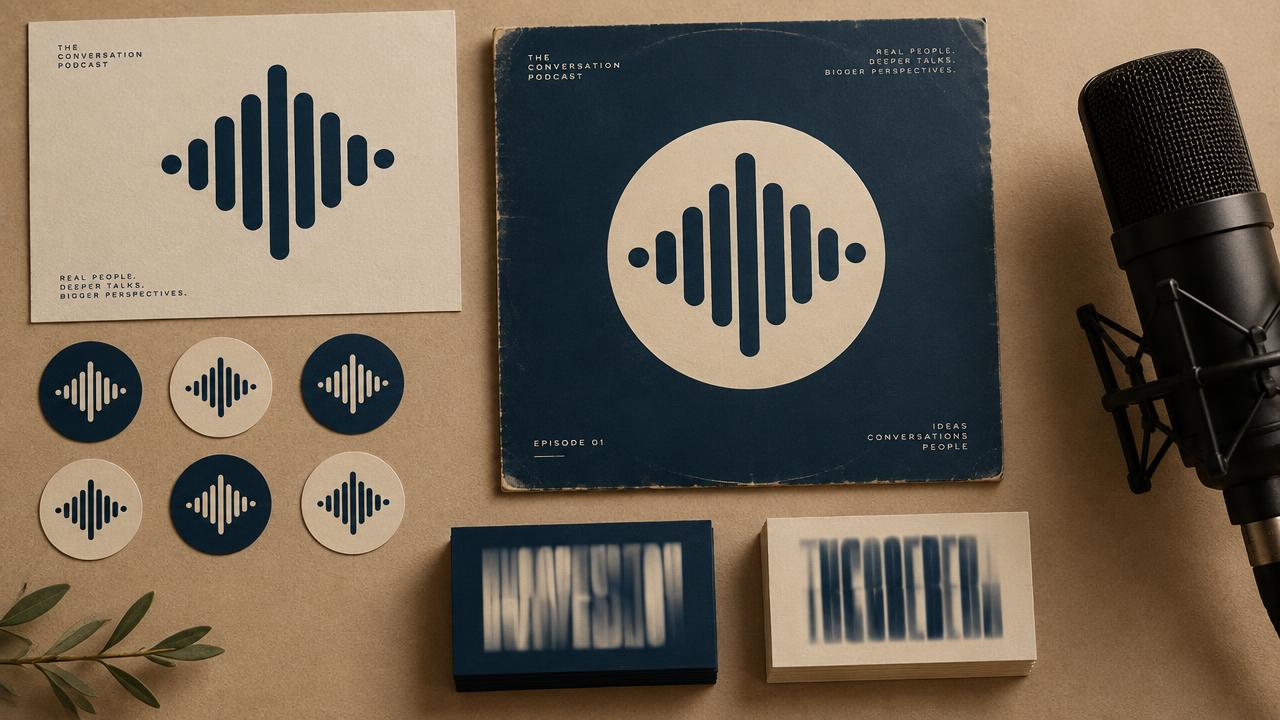
This workflow produces effective brand identity concepts by employing several specific prompt engineering techniques. Firstly, role priming establishes the model as a 'Brand Identity Designer specializing in audio media.' This immediately biases the model toward design principles relevant to podcasting, ensuring outputs consider the unique constraints and opportunities of audio branding.

Secondly, context setting through specific placeholders for podcast name, niche, audience, and host persona provides the model with critical information. This allows the generated brand elements to be highly tailored and relevant, rather than generic, ensuring the visual identity genuinely reflects the podcast's essence.

Thirdly, explicit constraints are used extensively. Directives like 'avoid overly complex,' 'abstract or typographic logo,' and specific color/typography requirements guide the model toward a desired aesthetic and style. This prevents undesirable outputs, such as literal illustrations or cluttered designs, and focuses the model on generating modern, clean, and adaptable visuals suitable for diverse platforms.

Finally, the structured output format is crucial. By demanding specific sections for logo concept, color palette, typography, sample compositions, and negative prompts, the prompt ensures a comprehensive and organized response. The inclusion of image prompts within the composition descriptions directly translates abstract concepts into actionable inputs for image generation models, bridging the gap between brand strategy and visual execution. This structured approach makes the output immediately usable for designers or further AI image generation.
Model fit

Best AI models for this prompt

Midjourney

Midjourney excels at generating highly aesthetic and stylized images, making it well-suited for exploring diverse visual brand concepts. Its ability to interpret abstract prompts and produce coherent visual themes helps in defining mood and atmosphere for a podcast identity. However, controlling precise typographic elements or ensuring consistent logo variations can be challenging, often requiring multiple iterations. See the full Midjourney hub for deeper guidance.

Flux

Flux offers strong capabilities for generating crisp, design-oriented visuals with good control over composition and color. It handles detailed style descriptions effectively, allowing for refined exploration of brand elements like specific textures or abstract logo forms. While it may require careful prompt engineering for complex layouts, its output quality is consistent for brand-focused imagery. See the full Flux hub for deeper guidance.

When to use

  • When initiating visual brand identity exploration for a new interview podcast.
  • For early-stage concept generation to inform design choices before engaging a graphic designer.
  • To quickly generate diverse visual directions for internal review or client presentations.
  • When needing specific, structured image prompts to feed into AI image generation tools.
  • To define a foundational visual language for an existing podcast undergoing a brand refresh.

When not to use

  • For generating final, production-ready brand assets or vector files; this output is conceptual.
  • If you already possess a detailed brand guide and only require minor asset adjustments.
  • When seeking highly illustrative, complex, or photographic styles that deviate from the prompt's constraints.
  • For branding needs unrelated to podcasts or audio media, as the focus is specific.
  • If you lack clear, descriptive inputs for the podcast's name, niche, audience, or host.

Get more from it

Pro tips

  • 1

    A detailed host persona description guides the AI's understanding of the brand's personality, preventing generic outputs.

  • 2

    Iterate on negative prompts by adding terms that represent undesirable elements observed in initial results.

  • 3

    Input specific HEX codes for colors to ensure consistency if you already have a preliminary palette in mind.

  • 4

    Describe typography by its intended feeling (e.g., 'authoritative sans-serif') to steer the AI towards appropriate font vibes.

  • 5

    Vary the sample compositions (cover, banner, header) to evaluate the brand system's adaptability across different media applications.

Don't ship this

Common mistakes

  • Providing vague descriptions for the podcast niche or host persona, leading to generic visual concepts.

    Fix — Detail the podcast's specific subject matter and the host's key personality traits for a distinct visual identity.

  • Expecting fully rendered, production-ready logos or art directly from the output.

    Fix — This prompt generates conceptual directions and image prompts; a human designer refines these into final assets.

  • Not iterating on the negative prompts list after reviewing initial generated images.

    Fix — Continuously add specific terms to exclude to eliminate unwanted styles, elements, or clutter from subsequent outputs.

  • Using overly complex or conflicting style descriptors, resulting in muddled or inconsistent visuals.

    Fix — Aim for clear, concise language that aligns with the 'modern, clean, adaptable' constraint for focused results.

  • Neglecting to specify desired textures or materiality, missing an opportunity to add depth.

    Fix — Even a brief mention like 'smooth gradients' or 'matte finish' can add consistency to the visual mood.

  • Reusing an identical image prompt for all three sample compositions, limiting versatility demonstration.

    Fix — Tailor each composition's prompt to its specific use case (cover, banner, header) for better contextual examples.

People also ask

Frequently asked questions

Q.Will this generate actual font files or vector logos that I can use immediately?

No, this prompt generates descriptions of font vibes and concepts for logos. It provides image prompts to visualize these ideas, but not production-ready files. A graphic designer will use these concepts to create final assets.

Q.How long should my input descriptions be for the podcast niche or host persona?

Aim for 1-3 concise sentences for each input field. Provide enough detail to be specific without being overly verbose. This allows the AI to grasp the core essence without getting lost in excessive information.

Q.Can I use this prompt for non-interview style podcasts, like narrative or documentary shows?

While designed for interview shows, you can adapt it. Adjust the podcast_niche and host_persona fields to fit other podcast formats. The core branding principles and output structure remain broadly applicable.

Q.What if I don't have HEX codes for my color palette yet, or just have a general idea?

You can use descriptive color names (e.g., 'deep forest green,' 'muted terracotta') or general color vibes (e.g., 'warm earth tones'). The AI will interpret these and suggest a palette based on your descriptions.

Q.Is this prompt compatible with all AI image generators, or just the ones listed?

The output image prompts are optimized for Midjourney and Flux, as specified. Other generators may require slight modifications to the prompt syntax or structure for optimal results due to varying interpretation methods.

Q.How many iterations should I expect to run to get a good result?

Typically, 2-4 iterations are sufficient. Initial runs help identify areas for refinement in your inputs, especially negative prompts and persona details. Subsequent runs then yield stronger conceptual directions.

Version 1.0Last reviewed July 23, 2026
Reviewed by PromptInFlow Editorial Team