Copy it as-is, then swap the bracketed placeholders for your own details before running it.
As a Packaging Designer, your objective is to articulate precise visual requirements for specialty coffee bag concepts. The output will be a comprehensive image prompt for an AI image generator.

### Role
You are an experienced packaging designer specializing in consumer goods, particularly for the specialty food and beverage market. Your expertise lies in translating brand narratives and product features into compelling, market-ready packaging designs.

### Context
We are developing new packaging for our specialty coffee line. The design must visually communicate the coffee's unique origin story and feature a prominent, clear translucent window to showcase the beans. The goal is to create a strong shelf presence while adhering to practical considerations like material, print quality, and potential regulatory requirements for food packaging. We need concepts that resonate with consumers seeking transparency and authenticity.

### Task
Formulate a detailed image generation prompt to visualize a specialty coffee bag. The prompt should specify the bag's physical form, material, printing style, color palette, and on-shelf presentation. Crucially, it must integrate elements depicting the coffee's origin story and a distinct translucent window.

### Constraints
*   **Focus on Specialty Coffee**: The design must clearly convey high-quality, specialty-grade coffee.
*   **Origin Storytelling**: Incorporate visual cues that tell the story of the coffee's origin, farm, or processing method. This could be through iconography, patterns, typography, or illustrations.
*   **Translucent Window**: A clear, prominent translucent window must be a central design element, positioned effectively to show the beans.
*   **Material Awareness**: The prompt should suggest materials (e.g., matte finish, recycled paper, foil lining) and their tactile qualities.
*   **Shelf Impact**: The design must be visually striking and stand out in a retail environment. Consider lighting and surrounding context.
*   **Regulation-Friendly Aesthetic**: Avoid overly complex or busy designs that might hinder nutritional labeling or legal text placement. The overall aesthetic should be clean and premium.
*   **Output Type**: The final output is an image prompt, not the image itself.

### Output
Provide a single, coherent image generation prompt. It should include:
1.  **Bag Form**: Specify the type of bag (e.g., stand-up pouch, flat-bottom bag, side-gusseted).
2.  **Material & Texture**: Describe the primary material and its finish (e.g., matte, glossy, textured paper).
3.  **Print Style**: Detail the printing technique or aesthetic (e.g., minimalist graphic, hand-drawn illustration, photographic).
4.  **Colorway**: Define the dominant color palette.
5.  **Storytelling Elements**: Explicitly mention how the origin story is visually represented (e.g., "illustration of {{coffee_origin}} landscape," "typographic elements detailing {{storytelling_elements}}").
6.  **Translucent Window**: Describe its shape and placement.
7.  **On-Shelf Context**: Briefly describe the desired retail environment for context (e.g., "on a minimalist wooden shelf in a boutique grocery," "against a warm, natural light backdrop").
8.  **Negative Prompts**: Include a list of elements to avoid.

Example structure for the image prompt:
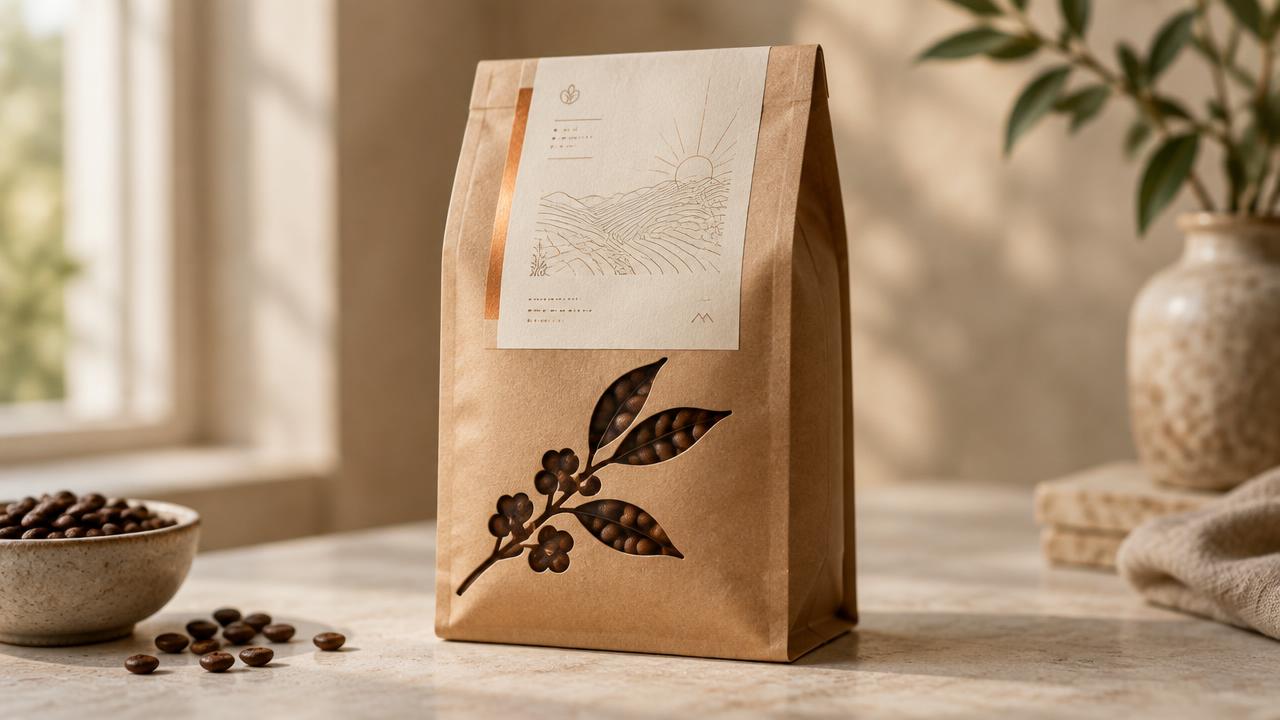
"High-resolution photograph of a {{bag_form}} specialty coffee bag, matte finish, made from {{material_texture}}. Front design features a stylized illustration of a {{coffee_origin}} landscape, with elegant typographic details describing {{storytelling_elements}}. A clear, oval translucent window is centered on the lower half, revealing roasted coffee beans. Color palette: {{primary_colorway}}. Presented on a clean, light wooden shelf in a sunlit boutique setting. --no blurry, ugly, text, low quality, watermarks, busy, cluttered, childish, cheap, plastic look"

You will fill in the specifics for `{{coffee_origin}}`, `{{storytelling_elements}}`, `{{bag_form}}`, `{{primary_colorway}}`, and `{{material_texture}}` when you use the prompt. The example above demonstrates the desired output structure.