Image AIProduct ShotsIntermediate60 minSaves 1 hour

Overhead Hot Sauce Product Shot: Textured Plate Styling

For specialty food brand teams, create an art-directed overhead product shot of your hot sauce, emphasizing artisanal presentation and precise lighting for marketing assets.

This prompt guides specialty food brands to generate an art-directed overhead product photograph of a hot sauce bottle. It specifies styling on a hand-thrown ceramic plate with fresh chilies, precise lighting, and shadow work, delivering high-quality visual assets for marketing and e-commerce.

READY-TO-USE PROMPT

Copy Prompt

prompt.txt
Your role is that of a seasoned product photography art director, tasked with meticulously crafting an image prompt for an AI image generation model.

**Context**
The objective is to produce a hero shot for a specialty food brand's marketing campaign. This image must convey authenticity, artisanal quality, and gourmet appeal, focusing on a single product. The visual narrative should be clean, intentional, and highlight the product within a curated, natural setting, suitable for both digital marketing and print collateral. We aim for a refined, yet approachable aesthetic that resonates with discerning consumers.

**Task**
Generate a comprehensive and precise image prompt designed to produce an overhead (flat lay) product photograph. The core subject is a hot sauce bottle positioned on a textured, hand-thrown ceramic plate. Integrate fresh, vibrant chilies as supporting elements. Crucially, specify lighting conditions and shadow play to enhance depth and warmth, ensuring the final image exudes a high-end, handcrafted feel. Include all necessary technical and aesthetic directives to guide the AI model effectively.

**Constraints**
*   The perspective must be strictly overhead, a perfect flat lay composition.
*   Maintain an art-director's tone throughout, prioritizing precise visual language for lighting, texture, and arrangement.
*   The prompt must explicitly detail the subject, styling elements, lighting setup, lens characteristics, and overall mood.
*   Provide two distinct aspect ratio options to cater to various deployment needs.
*   Include a robust list of negative prompts to prevent common image generation pitfalls and undesired elements.
*   Ensure the integration of at least two specific, bracketed placeholders for customization: `{{product_name}}` and `{{ceramic_plate_color}}`.

**Output Format**

Here is the structured image prompt:

**Subject**: A single, elegant `{{product_name}}` bottle, standing upright and centrally placed. The bottle should be clean, free of smudges, with a clear and legible label.

**Styling**: The bottle rests directly on a hand-thrown ceramic plate. The plate's color should be `{{ceramic_plate_color}}`, exhibiting a subtle, organic texture indicative of its handmade nature. Surrounding the bottle on the plate, and slightly spilling onto the immediate background, are several fresh, vibrant red and green chilies. Arrange them naturally, some whole, some halved, perhaps with a few loose seeds scattered to add an organic touch. The background surface is a clean, minimalist, matte finish, a neutral tone (e.g., light grey, off-white, or warm beige) that complements the plate without distracting from the main subject. Avoid busy patterns or reflective surfaces in the background.

**Lighting**: Employ soft, diffused overhead key lighting originating from the top-left quadrant. This setup should produce gentle, elongated shadows extending towards the bottom-right. The shadows of the bottle and chilies must be distinct yet soft, contributing to depth and dimension without appearing harsh or clipped. The light should highlight the textures of the ceramic plate and the chilies. A subtle fill light should be present to lift any deep shadows, ensuring no areas are completely black or lack detail. The overall effect should mimic natural daylight.

**Lens & Perspective**: Utilize a 100mm macro lens simulation. The aperture should be set to f/4 to achieve a shallow depth of field, ensuring the `{{product_name}}` bottle's label is in sharp focus, while the very edges of the background gently blur. The camera angle is directly overhead (90-degree flat lay).

**Mood**: Artisanal, gourmet, authentic, warm, inviting, premium, handcrafted, natural, clean.

**Aspect Ratios**:
*   `--ar 1:1` (for social media and square layouts)
*   `--ar 3:2` (for wider editorial or website banners)

**Negative Prompts**:
*   `--no text, branding, logos, watermarks, blurry, out of focus, poor composition, cluttered, low resolution, artificial light, harsh shadows, reflections, imperfections, smudges, hands, labels not legible, distorted perspective, glossy background, plastic, synthetic materials, excessive contrast, dull colors, oversaturation, cartoon, illustration, drawing`
Estimated results

DifficultyIntermediate
Setup time60 min
Time saved1 hour
Best modelsMidjourney, Flux
Best audienceSpecialty Food, E-commerce

Editor's note

Why this prompt matters

Creating compelling visual assets for specialty food brands often involves a significant investment in professional photography. Generic stock imagery rarely captures the unique artisanal quality and specific brand aesthetic that distinguishes a product in a crowded market. This workflow addresses the challenge of generating high-fidelity product shots with precise control over styling and lighting, without the overhead of a traditional photo shoot.

It is designed for product designers and marketing teams within specialty food companies who require art-directed visuals for campaigns, social media, or e-commerce. The ability to specify intricate details, from the texture of a ceramic plate to the subtle play of shadows, allows for rapid iteration on visual concepts and ensures brand consistency.

Reaching for this prompt is ideal when you need to visualize new product presentations, test different stylistic approaches, or quickly produce a suite of marketing images that convey authenticity and gourmet appeal. It provides a structured method to translate a precise art direction brief into a generative AI image, ensuring the output aligns with a high-end brand identity.

Anatomy

Prompt engineering breakdown

Role

You act as a seasoned product photography art director.

Context

The goal is to create a hero shot for a specialty food brand, emphasizing authenticity, artisanal quality, and gourmet appeal for a single product. The image needs to be clean, intentional, and suitable for marketing materials.

Goal

Generate a precise AI image prompt for an overhead (flat lay) product photograph. The focus is a hot sauce bottle on a textured, hand-thrown ceramic plate, with fresh chilies, specific lighting, and shadow play to convey a high-end, handcrafted feel.

Constraints

Strictly overhead (flat lay) perspective. Maintain an art-director's tone with precise visual language for lighting, texture, and arrangement. The prompt must detail subject, styling, lighting, lens, and mood. Include two aspect ratio options and a comprehensive list of negative prompts. Integrate {{product_name}} and {{ceramic_plate_color}} placeholders.

Output format

The output is a structured image prompt with clear sections: Subject, Styling, Lighting, Lens & Perspective, Mood, Aspect Ratios, and Negative Prompts.

Why this structure works

This prompt uses role priming to align the AI's persona with an expert photographer, ensuring precise visual language. Explicit constraints on perspective, tone, and required elements prevent deviations. The structured output format, with distinct sections for subject, lighting, and mood, reduces ambiguity and guides the AI to produce a comprehensive, high-quality image prompt.

Pick your version

Prompt variations

BeginnerBest with midjourney

When you are new to AI image prompts and need a straightforward guide to generate a basic product shot without extensive technical details.

prompt.txt
Create an overhead product photograph of a {{product_name}} bottle. Place the bottle centrally on a {{ceramic_plate_color}} handmade ceramic plate. The plate should have a subtle texture to show its artisanal quality. Arrange a few fresh, vibrant red and green chilies naturally around the bottle and plate. Use soft, diffused overhead lighting, coming from the top-left, to create gentle, elongated shadows that add depth without being harsh. The camera should be directly overhead for a flat lay view, ensuring the bottle's label is clearly readable. The overall image should convey an authentic, warm, and handcrafted feel. Include two aspect ratio options: --ar 1:1 for square social posts and --ar 3:2 for wider uses. Avoid text, blurry elements, harsh shadows, or any artificial-looking details in the final image.
ProfessionalBest with midjourney

For experienced users who require granular control over every visual element and wish to replicate the exact depth and precision of the original prompt.

prompt.txt
Your role is that of a seasoned product photography art director, tasked with meticulously crafting an image prompt for an AI image generation model. The objective is to produce a hero shot for a specialty food brand's marketing campaign, conveying authenticity and gourmet appeal. Generate a comprehensive and precise image prompt designed to produce an overhead (flat lay) product photograph. The core subject is a {{product_name}} bottle positioned on a textured, {{ceramic_plate_color}} hand-thrown ceramic plate. Integrate fresh, vibrant chilies as supporting elements. Crucially, specify soft, diffused overhead key lighting from the top-left to produce gentle, elongated shadows, enhancing depth and warmth. Utilize a 100mm macro lens simulation at f/4 for a shallow depth of field, focusing sharply on the bottle label. The overall mood should be artisanal, gourmet, and handcrafted. Include --ar 1:1 and --ar 3:2 options. Negative prompts: --no text, blurry, poor composition, harsh shadows, reflections, labels not legible, distorted perspective, glossy background, plastic.
Short VersionBest with flux

For rapid prototyping or when working with platforms that impose strict character limits on prompt inputs, requiring a condensed yet effective instruction.

prompt.txt
Overhead flat lay product photo: {{product_name}} bottle on a textured {{ceramic_plate_color}} hand-thrown ceramic plate. Arrange fresh red and green chilies naturally around it. Soft, diffused overhead lighting from top-left, casting gentle elongated shadows. Mimic 100mm macro lens, f/4, shallow depth of field, sharp label focus. Mood: artisanal, gourmet, handcrafted. Include --ar 1:1 and --ar 3:2. Negative prompts: --no text, blurry, harsh shadows, artificial light, plastic, cluttered, low resolution.
EnterpriseBest with midjourney

For corporate environments where brand consistency, legal compliance, and stakeholder review are critical aspects of image generation workflows.

prompt.txt
As a lead art director, generate an AI image prompt for a compliant, high-end overhead product shot, adhering strictly to brand guidelines for {{product_name}}. Subject: {{product_name}} bottle, centrally placed, label legible and aligned with brand assets. Styling: bottle on a {{ceramic_plate_color}} hand-thrown ceramic plate with organic texture, surrounded by fresh, non-GMO verified red and green chilies, arranged naturally to avoid artificiality. Background: neutral, matte finish, non-distracting. Lighting: Soft, diffused overhead key light (top-left) for gentle, elongated shadows, ensuring textures are highlighted and no brand elements are obscured. Shadows must be soft, not harsh, avoiding visual inconsistencies. Lens: 100mm macro simulation, f/4, ensuring product clarity and controlled depth of field, meeting accessibility standards for label readability. Mood: Artisanal, gourmet, authentic, premium, reflecting established brand values. Provide --ar 1:1 (social/marketing approval) and --ar 3:2 (editorial/web, pre-approved for legal review). Negative prompts: --no text, logos, branding (unless specified), watermarks, blurry, poor composition, copyrighted elements, harsh shadows, reflections, smudges, inconsistencies, artificial light, plastic, synthetic, oversaturation, dull colors, anything misrepresenting brand quality or values.

What you'll get

Expected output

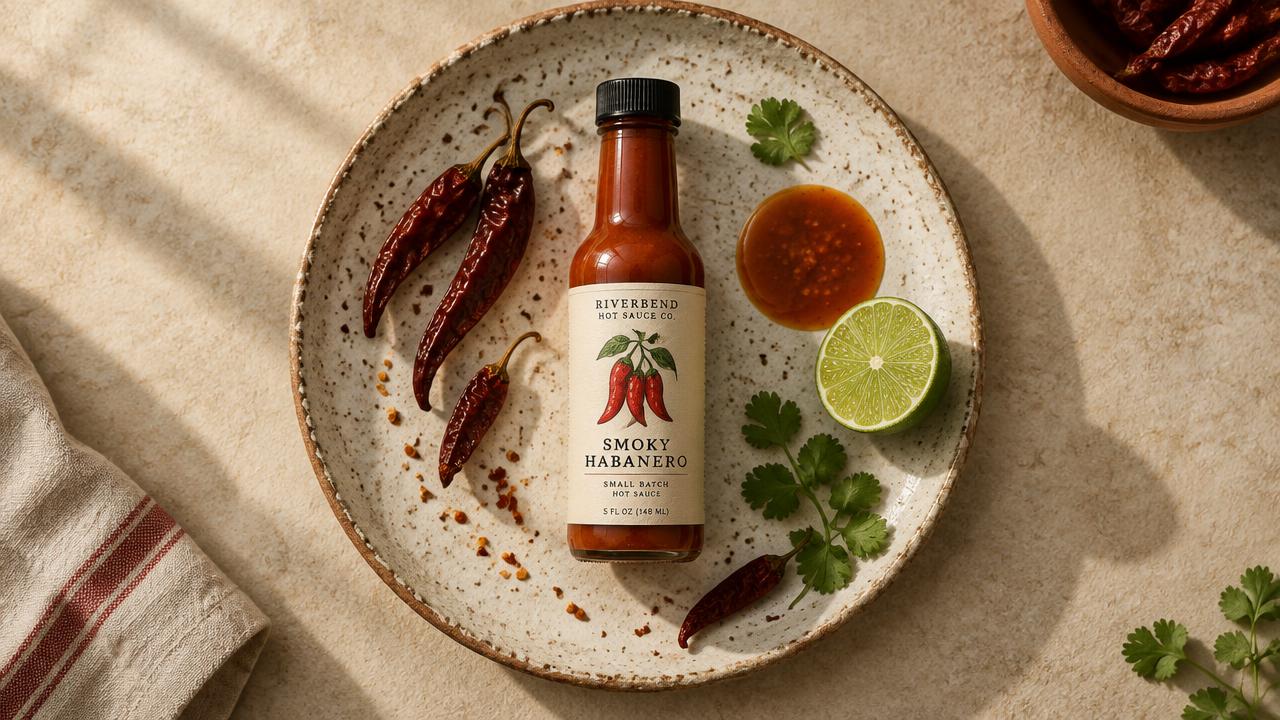
The image presents a perfectly overhead flat lay composition, centered on a single bottle of 'Fiery Ember Hot Sauce'. The bottle, made of clear glass with a dark label, stands upright and clean, its branding clearly legible. It rests directly on a round, hand-thrown ceramic plate of deep charcoal grey. The plate's surface exhibits a subtle, irregular texture that catches the light, conveying its handmade origin.

Arranged around the base of the bottle on the plate, and spilling slightly onto the immediate background, are several fresh chilies. These include vibrant, glossy red chilies and bright green serrano-style chilies. They are placed naturally, some whole, others visibly halved, revealing their inner membranes and seeds. A few scattered red chili seeds are visible on the plate and background, adding an organic detail.

The background surface is a clean, matte light beige, providing a neutral canvas that highlights the darker plate and colorful chilies without competing for attention.

Lighting is soft and diffused, originating from the top-left, casting gentle, elongated shadows towards the bottom-right of the frame. The bottle casts a distinct but soft shadow, as do the chilies, creating a sense of depth and dimensionality without harshness. The light subtly emphasizes the ceramic plate's texture and the slight sheen on the chilies. There are no deep, impenetrable shadows, indicating a subtle fill light that maintains detail across the scene. The overall illumination mimics natural daylight, creating a warm and inviting atmosphere.

The focus is sharp on the 'Fiery Ember Hot Sauce' bottle and its label, consistent with a simulated f/4 aperture from a 100mm macro lens. The very edges of the light beige background show a gentle, pleasing blur, isolating the main subject and its immediate surroundings. The image conveys an artisanal, gourmet, and authentic mood, suggesting a handcrafted, premium product.

Under the hood

Why this prompt works

This prompt workflow produces high-quality, art-directed images by employing several specific prompt engineering techniques. Firstly, role priming is established from the outset: 'Your role is that of a seasoned product photography art director...' This instructs the AI to adopt a precise, detail-oriented persona, ensuring the generated image prompt reflects professional visual language and technical specifications.

Contextual framing further refines the AI's understanding, outlining the brand's objective, target aesthetic, and desired emotional response. This helps the AI align its output with the overall marketing goal, moving beyond a literal interpretation of objects to capture the intended mood and quality.

The use of explicit constraints is critical. Directives like 'The perspective must be strictly overhead' and 'Maintain an art-director's tone throughout' prevent ambiguity and guide the AI toward a very specific output structure and style. Furthermore, the prompt mandates structured output, breaking down the image description into distinct categories: Subject, Styling, Lighting, Lens & Perspective, Mood, Aspect Ratios, and Negative Prompts. This ensures a comprehensive and technically complete image prompt is generated, rather than a vague, generalized description.

Detailed descriptive language within each section specifies precise visual elements, such as 'soft, diffused overhead key lighting' and 'hand-thrown ceramic plate exhibiting a subtle, organic texture.' This minimizes misinterpretation by the AI. Finally, a robust list of negative prompts explicitly tells the AI what to avoid, significantly reducing common artifacts and undesired elements like blurry textures or inaccurate branding, resulting in cleaner, more refined images.

Model fit

Best AI models for this prompt

Midjourney

Midjourney excels at generating highly aesthetic and stylized imagery, making it well-suited for product photography requiring a specific mood and texture. Its ability to interpret nuanced lighting descriptions and render realistic material properties like ceramic texture and liquid reflections is a key strength. However, precise control over text readability on labels can sometimes be challenging, requiring careful negative prompting. See the full Midjourney hub for deeper guidance.

Flux

Flux offers strong capabilities for detailed image generation, particularly in rendering complex compositions and maintaining consistency across elements. It handles specific material and lighting instructions effectively, producing images with good depth and realism. While it can produce high-quality results, achieving the exact art-directed style might require more iterative prompting compared to Midjourney's inherent aesthetic bias. See the full Flux hub for deeper guidance.

When to use

  • When you need a clean, consistent overhead shot for a single specialty food product, emphasizing its artisanal nature.
  • For e-commerce listings, social media posts, or print collateral where a high-end, handcrafted feel is essential.
  • To establish a consistent visual identity across a product line, allowing for easy substitution of product details.
  • When aiming to highlight product texture and subtle branding elements through controlled lighting and shallow depth of field.
  • Ideal for brands seeking to convey authenticity and gourmet appeal without complex scene arrangements.

When not to use

  • Not suitable for lifestyle photography involving human interaction or dynamic product use.
  • Avoid when a wide, environmental shot is required, showing the product in a broader context.
  • Do not use if the primary goal is to show the product in motion, such as pouring or being consumed.
  • Ineffective for product lineups or complex arrangements with multiple distinct items competing for attention.
  • Not designed for abstract or highly stylized imagery that deviates from a realistic product photograph.

Get more from it

Pro tips

  • 1

    Vary the `{{ceramic_plate_color}}` placeholder with specific hex codes or descriptive names (e.g., 'terracotta orange', 'forest green') to fine-tune color accuracy and avoid generic tones.

  • 2

    Iterate on the `fresh, vibrant red and green chilies` description. Specificity like 'Thai bird chilies' or 'smoked chipotle pods' refines the botanical details and overall aesthetic.

  • 3

    Adjust the `f/4` aperture slightly up or down in subsequent prompts if the label clarity or background blur isn't precisely as desired, preventing unwanted focus fall-off.

  • 4

    Experiment with the `diffused overhead key lighting` angle. Shifting it from 'top-left' to 'top-right' subtly alters shadow direction, which can impact the perceived warmth.

  • 5

    Refine the `matte finish, neutral tone` background description. Adding specific materials like 'limestone slab' or 'unvarnished wood' can introduce subtle, appropriate textures.

  • 6

    Periodically review the negative prompts. If an undesired element persists, add a more specific negative term to directly counteract it, preventing recurring image flaws.

Don't ship this

Common mistakes

  • Labels on the `{{product_name}}` bottle appear blurry, distorted, or unreadable, compromising brand identity and product recognition.

    Fix — Increase the simulated aperture (e.g., to f/5.6 or f/8) to deepen the depth of field, ensuring the entire label remains in sharp focus.

  • Shadows are too harsh, too light, or poorly defined, failing to create the desired depth and warmth, making the image look flat.

    Fix — Adjust the 'fill light' intensity or its description, ensuring 'gentle, elongated shadows' are distinct but not clipped, mimicking natural light more closely.

  • The ceramic plate lacks organic texture or appears too uniform, detracting from the handcrafted aesthetic and making it look machine-made.

    Fix — Emphasize terms like 'uneven glaze', 'subtle imperfections', or 'visible throwing lines' in the plate's description to reinforce its handmade quality.

  • Chilies look artificial, out of place, or are arranged too symmetrically, losing the natural, organic feel intended for the styling.

    Fix — Refine the chili description with terms like 'casually scattered', 'artfully disarrayed', or 'varied sizes' to enhance their natural appearance and placement.

  • The background is distracting, either too busy, reflective, or not complementing the main subject, drawing attention away from the product.

    Fix — Reinforce the 'clean, minimalist, matte finish' description. Explicitly state 'no patterns' or 'seamless surface' to ensure a neutral, unobtrusive backdrop.

  • The overall mood feels cold or sterile, failing to convey the 'artisanal, gourmet, warm, inviting' atmosphere specified in the prompt.

    Fix — Add descriptors like 'soft glow', 'golden hour tones', or 'cozy ambience' within the lighting section to infuse more warmth into the generated image.

People also ask

Frequently asked questions

Q.Can I use this prompt for other types of food products, like jams or olive oil?

Yes, this prompt is adaptable. Simply replace {{product_name}} with your specific product (e.g., 'artisanal jam jar') and adjust fresh, vibrant red and green chilies to relevant garnishes like 'fresh berries' or 'rosemary sprigs'. Maintain the overhead perspective and lighting principles.

Q.What if my product isn't a bottle? Will the prompt still work effectively?

The prompt is designed for items that stand upright and have a clear label. If your product is a pouch or a flat item, you might need to adjust the 'standing upright and centrally placed' and 'label is in sharp focus' directives for optimal results.

Q.How do I ensure the label text is always legible and sharp?

The prompt uses f/4 for shallow depth of field. If text isn't sharp, increase the simulated aperture (e.g., to f/5.6 or f/8). This deepens the focus plane, ensuring more of the product, including its label, is clear.

Q.Can I change the background surface to something other than a neutral tone?

Yes, but proceed with caution. The prompt specifies a neutral, minimalist background to keep focus on the product. If you introduce patterns or textures, ensure they are subtle and do not compete visually with the {{product_name}} bottle and plate. Keep it simple.

Q.I'm not getting the 'hand-thrown' look for the ceramic plate. How can I fix this?

Strengthen the description of the plate. Use more specific adjectives like 'irregular rim', 'visibly textured glaze', 'earthy tones', or 'organic imperfections' to guide the AI towards a less manufactured appearance. Also, ensure your {{ceramic_plate_color}} isn't too uniform.

Q.The shadows are too strong or too faint. How do I achieve the perfect balance?

Refine the 'Lighting' section. Experiment with terms like 'subtle fill light strength' or 'soft, barely-there shadows' if they are too prominent. If too faint, emphasize 'pronounced yet soft shadows' to get the desired depth without harshness.

Version 1.0Last reviewed July 23, 2026
Reviewed by PromptInFlow Editorial Team