Image AIConcept ArtAdvanced90 minSaves 2+ hours

Fantasy Ranger Concept: Northern Forest Cloaked Scout

Game concept artists can quickly generate detailed fantasy ranger character concepts set in a northern forest, accelerating visual development for new game projects.

This prompt helps game concept artists create illustrative fantasy character designs. Focus on a cloaked ranger in a northern forest setting, emphasizing cinematic mood, silver-gray palette, and detailed composition. It streamlines early-stage visual development for games.

READY-TO-USE PROMPT

Copy Prompt

prompt.txt
Role: You are an experienced concept artist and art director for a fantasy game studio.

Context: We are in the pre-production phase for a new dark fantasy RPG, internally codenamed "Ashwood Chronicles." The game emphasizes exploration, survival, and a grim, grounded aesthetic. The immediate need is a compelling character concept for a stealth-oriented ranger, specifically one adapted to harsh northern forest environments. This concept will serve as a foundational visual guide for our 3D modelers and illustrators, ensuring consistency in our art direction. We need to establish a distinct visual identity for this archetype.

Task: Formulate a detailed image generation prompt for a single character concept art piece. The character is a {{character_role}} operating within a {{primary_setting}}. The image should convey a specific {{mood_descriptor}} and adhere to a {{palette_description}}. The final output should be suitable for direct use in an image generation model.

Constraints:
*   **Tone:** The overall tone must be cinematic, emphasizing world-building and suggesting a deep character backstory through visual elements. The character should feel integrated into their environment, not merely placed within it.
*   **Render Style:** The desired aesthetic is an illustrative render, characterized by visible brushwork, defined textures, and a painterly quality, rather than photorealism. Think high-fidelity concept art.
*   **Character Focus:** The {{character_role}} must be the central element of the composition, commanding attention. Environmental details should support and enhance their presence, providing context without overshadowing the character.
*   **Palette:** The dominant color scheme must be silver-gray, with muted, desaturated secondary accents if absolutely necessary. The aim is to maintain a cold, stark, and almost monochromatic feel, reflecting the harsh northern setting.
*   **Cloak:** The character's cloak is a crucial visual element. It should suggest protection from the elements, facilitate stealth, and show signs of wear, implying a journey or long-term survival in the wilderness.
*   **Equipment:** Any visible equipment should be practical, worn, and fit the ranger archetype (e.g., bow, quiver, daggers, utilitarian pouches).

Output: Provide a single, concise image generation prompt structured with clear directives for an image model. The prompt should explicitly define:

*   **Subject:** A {{character_role}}, cloaked and weathered, positioned within a dense, snow-dusted {{primary_setting}}. Describe their posture (e.g., vigilant, poised, observing from cover), essential equipment, and any subtle features that communicate their expertise and resilience.
*   **Mood:** Clearly evoke a {{mood_descriptor}} atmosphere – mysterious, vigilant, solitary, perhaps with a hint of quiet determination or melancholy. The visual elements should reinforce this emotional tone.
*   **Lighting:** Specify the lighting conditions. Examples include: overcast light filtering through heavy tree canopy, dappled forest light at dawn, or a stark, cold twilight. Emphasize how shadows and highlights should be used to enhance depth and mood.
*   **Composition:** Detail the framing (e.g., medium shot, full body, slightly low angle looking up at the character). Describe key compositional elements like leading lines from ancient trees, mist or fog weaving through the scene, or a distant, blurred background suggesting vast wilderness.
*   **Camera:** Indicate the camera perspective and focal length if relevant, for instance, a slightly wide-angle lens to capture environmental context with the character prominent, or a longer focal length for a more compressed, focused view.
*   **Style Influences:** List 2-3 specific artists, art movements, or established game art styles that align with the desired illustrative and cinematic aesthetic (e.g., "inspired by Brom," "Dark Souls concept art," "Frazetta").
*   **Negative Prompts:** Include a comprehensive list of terms to avoid to ensure quality and prevent undesirable outputs. Examples: "cartoon," "anime," "ugly," "deformed," "low-resolution," "text," "signature," "watermark," "multiple characters," "bright colors," "child," "cute," "clean," "futuristic."

Estimated results

DifficultyAdvanced
Setup time90 min
Time saved2+ hours
Best modelsMidjourney, Flux
Best audienceGame Development, Art & Design

Editor's note

Why this prompt matters

Game development often faces bottlenecks in visual concept generation, particularly when establishing consistent art direction for new character archetypes. Concept artists and art directors need rapid iteration to explore visual themes and ensure designs align with the game's overall aesthetic and narrative. This workflow addresses the challenge of quickly generating detailed, high-fidelity character concepts that fit a specific artistic vision, reducing the time spent on initial sketches and variations.

This approach is for game concept artists, art directors, and indie developers working on fantasy RPGs or similar projects where visual consistency and thematic depth are critical. It provides a structured method for translating a creative brief into a concrete image generation prompt, focusing on key elements like mood, setting, and character attributes. Employing this workflow helps solidify early visual development, ensuring that 3D modelers and illustrators have a clear foundation to build upon. It is particularly useful when beginning a new character line or exploring variations within an established lore, allowing for focused exploration without manual redrawing of every iteration.

Anatomy

Prompt engineering breakdown

Role

You are an experienced concept artist and art director for a fantasy game studio.

Context

We are in the pre-production phase for a new dark fantasy RPG, internally codenamed "Ashwood Chronicles." The game emphasizes exploration, survival, and a grim, grounded aesthetic. The immediate need is a compelling character concept for a stealth-oriented ranger, specifically one adapted to harsh northern forest environments. This concept will serve as a foundational visual guide for our 3D modelers and illustrators, ensuring consistency in our art direction. We need to establish a distinct visual identity for this archetype.

Goal

Formulate a detailed image generation prompt for a single character concept art piece. The character is a {{character_role}} operating within a {{primary_setting}}. The image should convey a specific {{mood_descriptor}} and adhere to a {{palette_description}}. The final output should be suitable for direct use in an image generation model.

Constraints

Tone: cinematic, world-building, character integrated into environment. Render Style: illustrative, painterly, visible brushwork, not photorealism. Character Focus: central element, environmental details support. Palette: dominant silver-gray, muted desaturated secondary accents. Cloak: crucial, suggests protection, stealth, wear. Equipment: practical, worn, ranger archetype (bow, quiver, daggers, pouches).

Output format

Provide a single, concise image generation prompt structured with clear directives for an image model. The prompt should explicitly define: Subject, Mood, Lighting, Composition, Camera, Style Influences, Negative Prompts.

Why this structure works

This prompt's effectiveness stems from its explicit constraints on tone, style, and palette, which guide the model towards the desired dark fantasy aesthetic. Role priming as a concept artist ensures the output aligns with professional game development standards. The structured output format, breaking down the image into specific elements like subject, mood, and lighting, provides clear directives for the image generation model.

Pick your version

Prompt variations

BeginnerWorks with any model

For users new to AI image generation, or when a less prescriptive output is acceptable. Focuses on core elements without extensive technical details.

prompt.txt
Create a concept art image prompt for a fantasy game character. We need a {{character_role}}, like a ranger, wearing a cloak in a {{primary_setting}}, such as a cold forest. The picture should feel {{mood_descriptor}}, maybe mysterious and quiet. Use a {{palette_description}}, mainly silver-gray colors. The character should be the main focus, showing their gear and how they live in the wild. Make it look like a painted illustration, not a real photo. Include details about simple lighting and a clear view of the character. Avoid cartoons or very bright colors.
ProfessionalBest with midjourney

When experienced users require a comprehensive and highly detailed prompt that mirrors professional art direction standards. Suitable for fine-tuning outputs.

prompt.txt
As a concept artist, generate a detailed image prompt for a {{character_role}} in a dark fantasy RPG. The character, a cloaked scout, operates in a {{primary_setting}}. The prompt must define: Subject: A weathered {{character_role}} in a dense, snow-dusted {{primary_setting}}. Describe posture (e.g., vigilant, poised), essential equipment, and resilience. Mood: Evoke a {{mood_descriptor}} atmosphere—mysterious, solitary, determined. Lighting: Specify conditions like overcast light through canopy or cold twilight, emphasizing shadows for depth. Composition: Detail framing (e.g., medium shot), compositional elements like leading lines from trees, mist. Camera: Indicate perspective (e.g., slightly wide-angle to capture context). Style Influences: List 2-3 artists/styles (e.g., 'inspired by Brom,' 'Dark Souls concept art'). Negative Prompts: Avoid 'cartoon,' 'anime,' 'low-resolution,' 'bright colors,' 'multiple characters,' 'child,' 'futuristic.' Focus on an illustrative, cinematic render with a silver-gray {{palette_description}}.
Short VersionBest with flux

For quick iterations or when working with models that respond well to condensed inputs. Prioritizes brevity while retaining core creative direction.

prompt.txt
Generate an image concept prompt for a {{character_role}}, a cloaked ranger, set in a grim {{primary_setting}}. The {{mood_descriptor}} tone should be cinematic and illustrative, emphasizing a silver-gray {{palette_description}}. Focus on the character as the central subject, showing practical, worn equipment and a weathered cloak. Define lighting (e.g., cold twilight), a medium-shot composition, and suggest influences like dark fantasy concept art. Include negative prompts to avoid photorealism, bright colors, or cartoon styles, ensuring a stark, grounded aesthetic for game development.
EnterpriseBest with midjourney

For large organizations where brand consistency, stakeholder review, and compliance with established art guidelines are critical. Incorporates language for internal approval processes.

prompt.txt
As lead concept artist, formulate a comprehensive image generation prompt for a {{character_role}} character concept, adhering strictly to our 'Ashwood Chronicles' visual guidelines. The character, a cloaked scout, operates within a {{primary_setting}}. This prompt must define: Subject: A resilient {{character_role}} within a dense, snow-dusted {{primary_setting}}, communicating their role and backstory. Mood: Evoke a {{mood_descriptor}} atmosphere, aligning with the game's grim aesthetic. Lighting/Composition: Detail conditions (e.g., overcast) and framing to support character focus and world-building. Style Influences: Propose 2-3 established art styles (e.g., 'Dark Souls concept art') for consistency. Compliance: Ensure the {{palette_description}} (silver-gray) and illustrative render style align with brand standards. All visual elements must support the narrative and pass stakeholder review. Negative Prompts: Include terms to prevent off-brand or technically flawed outputs (e.g., 'cartoon,' 'bright colors,' 'unapproved styles'). This prompt will be reviewed by the art director and project lead for final approval before asset creation.

What you'll get

Expected output

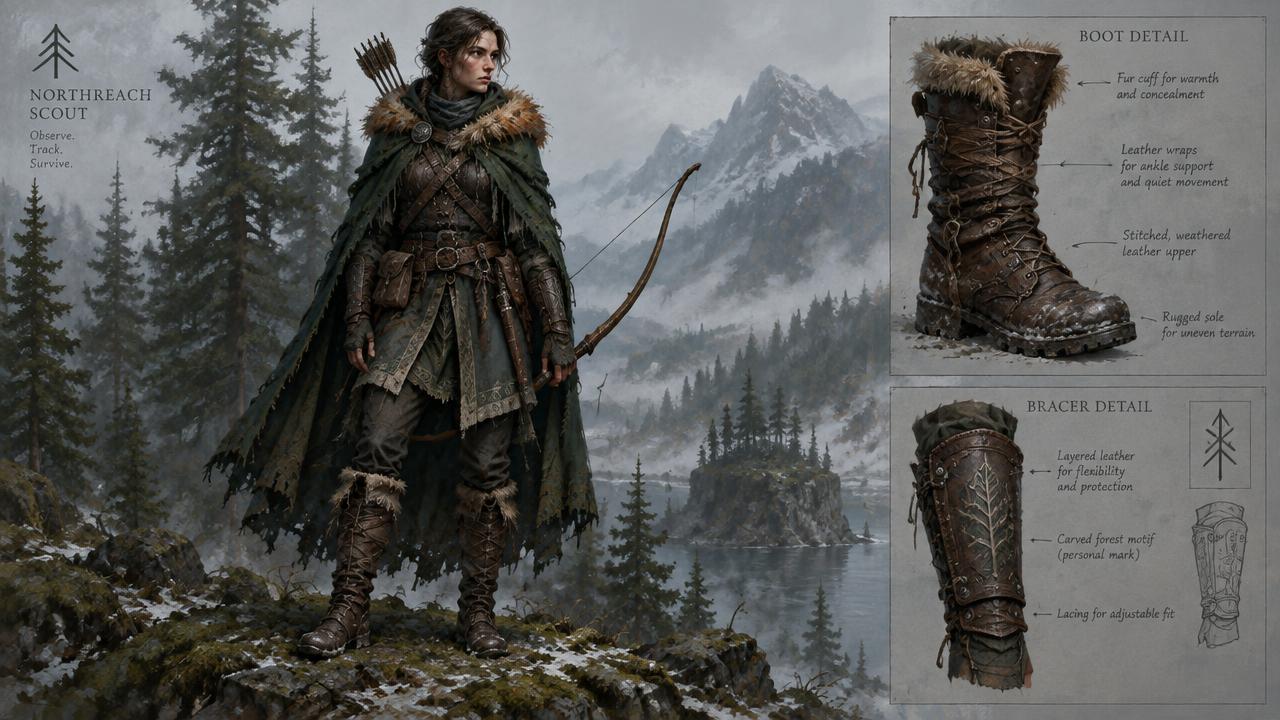
Using the input parameters of character_role: "stealthy northern ranger", primary_setting: "ancient, snow-dusted boreal forest", mood_descriptor: "somber and vigilant", and palette_description: "stark silver-gray with desaturated forest greens", the prompt would generate the following image generation prompt:

"Subject: A stealthy northern ranger, cloaked and weathered, positioned within a dense, snow-dusted ancient, snow-dusted boreal forest. The ranger is crouched low, one hand resting on a gnarled tree trunk, observing the unseen with keen, narrowed eyes. A recurve bow is slung across their back, a quiver of fletched arrows visible, and a worn hunting knife is sheathed at their hip. Their posture communicates quiet readiness and deep familiarity with the wilderness, subtle scarring on exposed skin hints at past encounters.

Mood: Clearly evoke a somber and vigilant atmosphere – mysterious, solitary, with a strong hint of quiet determination. The visual elements should reinforce this emotional tone of patient watchfulness in a harsh environment.

Lighting: Overcast light filters weakly through a heavy canopy of ancient, snow-laden pines. Patches of diffused light highlight the ranger's silhouette and the texture of their cloak, while deep, soft shadows obscure their features, adding to the mystery. The overall illumination is cold and desaturated, emphasizing the starkness of the northern setting.

Composition: A medium shot, slightly low angle looking up at the character, placing the ranger prominently in the lower-middle frame. Ancient, snow-covered tree trunks form leading lines, drawing the eye towards the character. Wisps of cold mist weave through the undergrowth at their feet. The background is a blurred expanse of dense forest, suggesting vast, untamed wilderness stretching beyond.

Camera: Slightly wide-angle lens (e.g., 28mm-35mm equivalent) to capture both the character's presence and a sense of their immediate environment, with the ranger remaining the primary focal point. Shallow depth of field to isolate the character from the background, enhancing their prominence.

Style Influences: Inspired by the concept art of Dark Souls, the atmospheric illustrations of Brom, and the narrative depth of Frazetta's character studies. Illustrative render, painterly brushwork, defined textures.

Negative Prompts: cartoon, anime, ugly, deformed, low-resolution, text, signature, watermark, multiple characters, bright colors, child, cute, clean, futuristic, happy, smiling, vibrant, sci-fi, urban, desert."
Under the hood

Why this prompt works

This workflow produces superior results compared to a simple, one-line request due to its structured approach and specific prompt engineering techniques. Role priming, established at the outset, instructs the model to adopt the persona of an "experienced concept artist and art director." This immediately frames the task within a professional creative context, guiding the model toward outputs that align with industry standards for game concept art.

The inclusion of detailed context about the "Ashwood Chronicles" project and the specific needs for a "dark fantasy RPG" provides critical background information. This allows the model to generate prompts that are thematically coherent and stylistically appropriate for the intended game world. Explicit constraints regarding tone, render style, character focus, and palette prevent drift and ensure the output adheres closely to the desired aesthetic. For instance, demanding an "illustrative render" with "visible brushwork" directly counters tendencies toward photorealism or simplified styles.

Finally, the structured output mandate, breaking the image prompt into distinct sections like Subject, Mood, Lighting, Composition, Camera, Style Influences, and Negative Prompts, forces a comprehensive and organized response. This granular instruction ensures all critical visual parameters are addressed, leading to a highly specific and actionable image generation prompt that minimizes ambiguity and maximizes the likelihood of a relevant, high-quality visual output. This level of detail is impossible to achieve with a brief, unstructured prompt.

Model fit

Best AI models for this prompt

Midjourney

Midjourney excels at generating illustrative and cinematic styles, with a strong understanding of mood and lighting. It is particularly effective for detailed character concepts, handling complex descriptions well. However, it can sometimes lean too heavily into a generic fantasy aesthetic without explicit constraint, requiring careful negative prompting to guide the output. See the full Midjourney hub for deeper guidance.

Flux

Flux is known for its ability to render complex compositions and intricate details, making it highly suitable for character design. It generally handles specific stylistic instructions effectively. Users may find that achieving precise illustrative brushwork requires more iterative prompting if not clearly specified in the initial input. See the full Flux hub for deeper guidance.

When to use

  • When developing initial visual concepts for a dark fantasy RPG character, specifically for stealth or wilderness archetypes.
  • To establish a consistent art direction early in pre-production for character designs tied to specific harsh environments.
  • For generating multiple variations of a cloaked ranger or scout, focusing on equipment and posture within a northern setting.
  • When you need high-fidelity concept art that leans painterly and illustrative, not photorealistic.
  • To quickly explore different interpretations of a character's mood and integration with their environment.

When not to use

  • If you require final, production-ready 3D model sheets or highly detailed orthographic views.
  • For generating photorealistic renders or images intended for live-action visual effects.
  • When the character needs to be part of a group or interacting with other figures.
  • If the project demands a vibrant, high-saturation color palette or a different art style like anime or cartoon.
  • For character concepts that are not wilderness-oriented or do not feature cloaks as a central design element.

Get more from it

Pro tips

  • 1

    Vary the `{{mood_descriptor}}` input to explore a wider emotional range for the character, preventing a monotonous output.

  • 2

    Experiment with specific `{{primary_setting}}` details like 'ancient snow-laden pines' or 'frozen waterfall' to better integrate the character and avoid generic backgrounds.

  • 3

    Refine the `{{palette_description}}` beyond 'silver-gray' with subtle additions like 'frost-kissed silver' or 'charcoal accents' to achieve precise tonal control and prevent flat results.

  • 4

    Adjust the 'Style Influences' by swapping artists or game titles to shift the illustrative quality, ensuring the render matches your studio's specific aesthetic.

  • 5

    Iterate on `{{character_role}}` descriptions; adding adjectives like 'veteran' or 'weary' can deeply influence the character's visual narrative and prevent generic portrayals.

  • 6

    Use highly specific negative prompts to filter out undesired stylistic elements or artifacts, preventing common AI hallucination issues like extra limbs or text.

  • 7

    Test different camera angles and focal lengths in your prompt to find the most impactful cinematic view, avoiding static or uninspired compositions.

Don't ship this

Common mistakes

  • The generated image lacks the intended cold, stark 'silver-gray' palette, often introducing warmer tones or excessive saturation.

    Fix — Reinforce 'monochromatic silver-gray' and explicitly add negatives like 'warm colors', 'bright colors', 'saturated' to guide the model.

  • The character appears disconnected from the environment, resembling a cutout placed on a background rather than an integrated figure.

    Fix — Emphasize environmental interaction in the subject and composition, e.g., 'snow dusting their cloak', 'shadows cast by ancient trees upon them'.

  • The render style veers into photorealism or an overly smooth, digital look, losing the desired illustrative, painterly quality.

    Fix — Strengthen 'illustrative render', 'painterly', 'visible brushwork' and add negatives like 'photorealistic', 'smooth', 'digital art' without texture.

  • The character's cloak lacks detail or appears generic, failing to convey wear, protection, or stealth as critical elements.

    Fix — Expand the cloak description with terms like 'weathered fabric', 'hooded for concealment', 'layered against the cold', 'tattered edges'.

  • The mood is generic fantasy, not the specific 'dark fantasy RPG' cinematic tone with world-building depth.

    Fix — Use stronger mood descriptors like 'somber vigilance', 'grim determination', 'ancient forest secrets', and reference dark fantasy game art styles.

  • The composition feels flat or uninspired, lacking the dynamic framing and depth expected for cinematic concept art.

    Fix — Specify detailed compositional elements like 'leading lines of branches', 'mist swirling around their feet', 'depth of field focusing on character'.

People also ask

Frequently asked questions

Q.Can I use this prompt for other fantasy archetypes besides rangers?

Yes, you can adapt the {{character_role}} and {{primary_setting}} to suit other archetypes like a cloaked sorcerer, a druid, or a barbarian in a similar environment. Ensure the equipment and mood descriptors align with your new character concept.

Q.How do I ensure the character's face isn't obscured if I want to see their expression?

While the prompt emphasizes the cloak, you can specify 'hood slightly back, revealing a stern expression' or 'face partially obscured by shadow, eyes piercing through'. Adjust the composition to a closer shot if needed.

Q.Will this prompt work for generating multiple characters in a single image?

No, this prompt is designed specifically for a single character concept. The 'Character Focus' constraint explicitly states the {{character_role}} must be the central element. Generating multiple characters requires a different prompt structure and likely different negative prompts.

Q.What if I need a different primary color palette than silver-gray?

You can change the {{palette_description}} to your desired scheme. However, be prepared to adjust the 'negative prompts' and potentially the 'mood' descriptors to maintain coherence. For instance, 'muted forest greens and earthy browns' would require different negative terms.

Q.How detailed should my inputs for `{{character_role}}` or `{{primary_setting}}` be?

Aim for concise but evocative detail. For {{character_role}}, include 3-5 key descriptive words. For {{primary_setting}}, 5-10 words describing key features (e.g., 'dense ancient pines, snow-covered ground, faint mist'). Specificity helps guide the AI without over-constraining it.

Version 1.0Last reviewed July 23, 2026
Reviewed by PromptInFlow Editorial Team