Image AIConcept ArtAdvanced90 minSaves 2+ hours

Tundra Apex Predator Concept for Survival Game

For creature designers in game development, generate a visually compelling and anatomically plausible apex predator concept for a tundra survival game, emphasizing a muted color scheme.

This prompt helps game creature designers generate realistic apex predator concepts for tundra survival games. It focuses on anatomical believability, a muted color palette, and cinematic world-building to produce high-fidelity concept art.

READY-TO-USE PROMPT

Copy Prompt

prompt.txt
Generate a comprehensive concept art prompt for an image generation AI. This prompt should guide the AI to create a visually compelling and anatomically plausible apex predator for a tundra environment, suitable for a survival game. Focus on details that convey its role as a top predator and its adaptation to extreme cold.

**Role:** Concept Artist specializing in creature design for survival games.
**Context:** The project requires an apex predator for a survival game set in a harsh, frozen tundra. The creature needs to feel genuinely integrated into this ecosystem, prioritizing believability and environmental adaptation over fantasy.
**Task:** Develop a detailed concept art prompt for an image AI.
**Constraints:**
- **Anatomical Realism:** The creature's physiology must clearly demonstrate adaptations for survival in a frozen, sparse environment. Consider features for insulation, hunting in snow, and navigating icy terrain. Avoid overtly fantastical elements.
- **Muted Color Palette:** The color scheme should be natural, desaturated, and suitable for camouflage within a snowy, icy landscape. Think grays, whites, pale blues, and browns.
- **Cinematic World-Building:** The final image should evoke a sense of scale, danger, and the creature's dominance within its environment. It should feel like a still from a high-budget nature documentary or a cinematic game trailer.
- **Output Structure:** The generated prompt must follow this specific structure:
  - **Subject:** Detailed description of the `{{creature_name}}`, including its primary form, key `{{specific_anatomical_feature}}`, and any unique adaptations.
  - **Mood:** Adjectives describing the overall feeling (e.g., predatory, isolated, ancient, resilient).
  - **Lighting:** Specifics on light source, intensity, and color (e.g., harsh winter sun, overcast, twilight, aurora borealis).
  - **Composition:** Framing, rule of thirds, leading lines, depth of field, interaction with environment.
  - **Camera:** Lens type, angle, perspective (e.g., wide-angle, low-angle, eye-level, telephoto).
  - **Style Influences:** Specific artists, art movements, or visual styles to emulate (e.g., Zdzislaw Beksinski, HR Giger, natural history illustration, cinematic realism).
  - **Negatives:** Elements to explicitly avoid (e.g., 'cartoonish', 'cute', 'humanoid features', 'bright colors', 'fantasy elements').

**Output:** Ensure the prompt is detailed enough for an AI to generate a high-fidelity concept image without further clarification. The goal is a creature that feels like it could exist, a true apex predator of the tundra.

Estimated results

DifficultyAdvanced
Setup time90 min
Time saved2+ hours
Best modelsMidjourney, Flux
Best audienceGame Development, Entertainment

Editor's note

Why this prompt matters

Concepting believable, biome-specific creatures for survival games requires extensive research and iterative design. Manually sketching and refining these initial ideas to meet strict anatomical and aesthetic criteria for a game's world can be a slow process, especially when aiming for a cohesive visual language. Designers often struggle to quickly generate varied yet consistent initial visual directions that align with a game's core principles, such as environmental adaptation and a specific mood. This workflow addresses that challenge by providing a structured method to generate detailed concept art prompts for AI image models. It's designed for creature designers and game artists who need to rapidly explore ideas for new species within a defined game world, particularly those requiring strong environmental integration and a realistic feel. By articulating precise requirements for anatomy, color, and cinematic presentation, the workflow ensures that the AI's output serves as a solid foundation for further development, saving significant time in the preliminary design phase and maintaining artistic direction. It's particularly useful when establishing the visual identity of a new game or expanding the bestiary of an existing one, where consistency and believability are paramount.

Anatomy

Prompt engineering breakdown

Role

The AI is instructed to act as a Concept Artist specializing in creature design for survival games.

Context

The project requires a believable apex predator adapted to a harsh tundra environment for a survival game, emphasizing realism over fantasy.

Goal

Generate a detailed concept art prompt for an image AI, ensuring the output is a visually compelling and anatomically plausible tundra apex predator, highlighting its role and cold adaptations.

Constraints

Key constraints include anatomical realism specific to frozen environments, a muted and camouflaged color palette, a cinematic world-building tone, and a strictly defined output structure.

Output format

The output must be a concept art prompt structured into specific sections: Subject, Mood, Lighting, Composition, Camera, Style Influences, and Negatives.

Why this structure works

Role priming immediately sets the AI's perspective and expertise. Explicit constraints on anatomical realism and color palette ensure the output aligns with project requirements. The structured output format guides the AI to produce a comprehensive, ready-to-use prompt for image generation, covering all critical artistic elements.

Pick your version

Prompt variations

BeginnerWorks with any model

When you need a basic creature idea quickly and aren't familiar with detailed art terms.

prompt.txt
Create a simple prompt for an AI to design a tundra creature. It should be a predator, strong and adapted to the cold. Think about its fur or skin, how it moves in snow, and what colors it would have (grays, whites). The picture should look like a movie scene.
Output sections:
- **Creature:** Describe `{{animal_type}}` and its main features.
- **Feeling:** How it makes you feel (e.g., scary, lonely).
- **Light:** What kind of light (e.g., sunny, dark, snowy).
- **View:** How the creature is seen (e.g., close-up, far away).
- **Style:** What kind of art it should look like.
- **Don't Include:** Things to avoid (e.g., cartoons, bright colors).
ProfessionalBest with midjourney

For experienced designers seeking precise control over every aspect of the AI-generated concept.

prompt.txt
Formulate an advanced concept art prompt for an image generation AI, focusing on a tundra apex predator for a survival game. The creature must exhibit verifiable biological adaptations for extreme cold and demonstrate a believable position within its ecosystem.
**Guidelines:**
- **Physiology:** Describe `{{primary_body_type}}` with specific adaptations like `{{insulation_type}}`, specialized `{{limb_structure}}` for snow/ice traversal, and sensory organs suitable for low visibility. Avoid any overt fantasy elements.
- **Coloration:** A naturally desaturated palette, emphasizing camouflage: `{{primary_color}}`, `{{secondary_color}}`, ice blues, and muted browns.
- **Art Direction:** The final output should convey scale, inherent danger, and environmental mastery, akin to a cinematic frame from a nature documentary.
- **Required Prompt Elements:**
    - **Subject:** Detailed profile of the `{{creature_species}}`, including unique `{{hunting_adaptations}}`.
    - **Atmosphere:** Evocative descriptors (e.g., desolate, ancient, formidable).
    - **Illumination:** Specify light source, quality, and mood (e.g., low arctic sun, blizzard whiteout, crepuscular light).
    - **Compositional Strategy:** Framing, `{{focal_point}}`, environmental integration.
    - **Camera Setup:** Lens choice, `{{camera_angle}}`, depth of field.
    - **Artistic References:** `{{artist_reference}}`, `{{style_reference}}`, natural history illustration.
    - **Exclusions:** 'cartoon', 'anthropomorphic', 'vibrant hues', 'fantasy wings'.
Short VersionBest with flux

When rapid ideation is needed, or for models that perform better with concise instructions.

prompt.txt
Generate a concise concept art prompt for an image AI: a realistic tundra apex predator for a survival game. Focus on anatomical adaptations for cold, a muted color palette (grays, whites, pale blues), and a cinematic feel. The prompt should include sections for Subject (detailing `{{creature_form}}` and `{{unique_feature}}`), Mood (e.g., dangerous, isolated), Lighting (e.g., harsh winter light), Composition, Camera (e.g., low-angle), Style Influences (e.g., natural realism), and Negatives (e.g., 'cartoony', 'bright colors'). Ensure believability and environmental integration.
EnterpriseBest with midjourney

For large studio projects where concept art must align with strict brand guidelines, IP, and stakeholder expectations, often requiring internal review.

prompt.txt
Develop a comprehensive concept art prompt for an image generation AI, compliant with internal IP guidelines, to visualize a new tundra apex predator for our survival game title. This creature must adhere to strict anatomical realism for its harsh environment, demonstrating clear adaptations for cold survival and a muted, camouflaged palette. The final output must maintain a cinematic, world-building quality suitable for a AAA production, ensuring it avoids any infringement on existing intellectual property or brand aesthetics. The prompt must be structured for stakeholder review, including: Subject (detailing `{{creature_designation}}` and `{{critical_adaptation}}`), Mood (e.g., formidable, ancient), Lighting (e.g., sub-arctic dawn, overcast), Composition (e.g., `{{environmental_interaction}}`), Camera (e.g., `{{lens_type}}`, `{{shot_perspective}}`), Style Influences (e.g., `{{approved_artist_reference}}`, `{{cinematic_style}}`), and explicit Negatives (e.g., 'fantastical elements', 'unapproved color schemes', 'cartoonish rendering', 'humanoid features'). This prompt facilitates internal review and ensures brand consistency.

What you'll get

Expected output

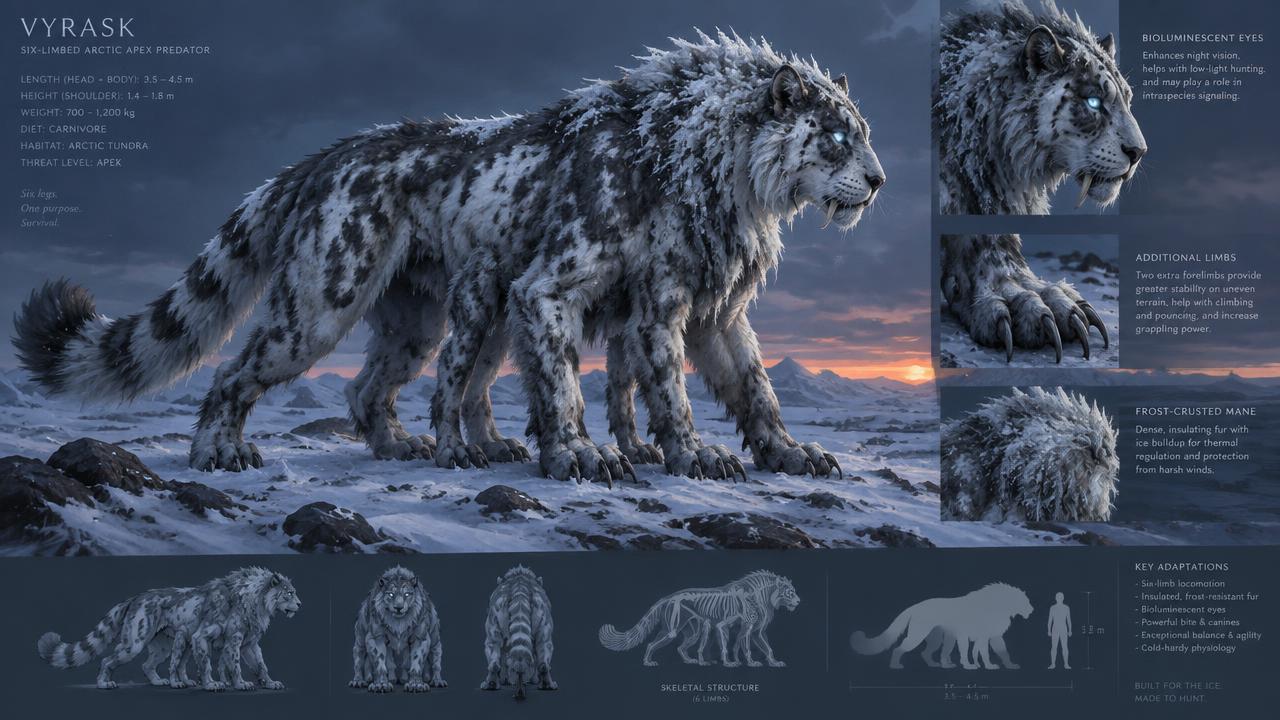
Subject: A Frostback Lurker, a massive quadrupedal predator resembling a blend of a polar bear and a wolverine, but scaled for a hostile tundra environment. Its body is covered in dense, ice-resistant fur plating, particularly thick along its spine and shoulders, providing both insulation and protection. Its forelimbs are heavily muscled, ending in broad, shovel-like claws adapted for digging through packed snow and ice to uncover prey or create temporary shelters. The head is low-slung with a capable jawline, featuring elongated, serrated teeth designed for crushing bone. Small, deeply set eyes are protected by a bony ridge, minimizing glare from snow. A thick, counterbalancing tail aids in stability on slippery terrain and can be used as a blunt weapon. Its overall form suggests immense strength and cold-weather endurance, with a slightly hunched posture indicating a constant hunt for sustenance.Mood: Predatory, isolated, ancient, resilient, formidable, desperate for survival. The atmosphere should convey the harshness of its existence and its undisputed dominance within its territory.Lighting: Harsh, low-angle winter sun breaking through a heavy, overcast sky, casting long, stark shadows. The light should be desaturated, emphasizing the cold and the muted palette of the environment. Hints of diffuse, pale blue light reflecting off snow and ice.Composition: Low-angle shot, making the Frostback Lurker appear monumental against a vast, desolate tundra backdrop. The creature is positioned slightly off-center, adhering to the rule of thirds, with its gaze directed towards the viewer but conveying a sense of indifferent observation. Leading lines from distant snowdrifts converge towards the creature, emphasizing its isolation and command of the landscape. Shallow depth of field, blurring the extreme foreground and background to keep focus on the creature.Camera: Wide-angle lens (e.g., 24mm), positioned at ground level to emphasize scale and power. Eye-level perspective with the creature to convey direct confrontation. Slightly Dutch angle to add tension.Style Influences: Wildlife photography from Arctic regions, concept art by Simon Stålenhag for environmental mood, the creature design principles of 'The Last of Us' for grounded realism, and traditional natural history illustrations for anatomical accuracy.Negatives: 'cartoonish', 'cute', 'anthropomorphic features', 'bright colors', 'fantasy elements', 'exaggerated proportions that defy physics', 'glowing eyes', 'unnatural bioluminescence', 'excessive gore'.
Under the hood

Why this prompt works

This workflow produces high-quality outputs because it grounds the AI in a specific professional persona through role priming. By instructing the AI to act as a "Concept Artist specializing in creature design," the model adopts a mindset geared towards practical, industry-relevant outputs rather than generic image descriptions. The explicit constraints for "Anatomical Realism," "Muted Color Palette," and "Cinematic World-Building" are crucial; they funnel the AI's creative capacity into a tight framework, ensuring the output aligns with the demanding requirements of game development. This prevents the generation of overly fantastical or visually inconsistent concepts. Furthermore, the detailed structured output requirement, specifying sections like Subject, Mood, Lighting, and Composition, forces the AI to break down the concept into actionable components. This systematic approach results in a comprehensive prompt that leaves little ambiguity for subsequent image generation models, directly addressing all facets of a professional concept art brief. The initial "Context" section establishes the underlying world-building principles, further refining the AI's understanding of the creative brief. Finally, the inclusion of negative constraints acts as a critical filter, preventing common pitfalls and undesirable stylistic deviations, thereby guiding the AI towards a more refined, usable concept from the outset. This multi-layered approach ensures a detailed, coherent, and purpose-driven output superior to a simple, unstructured request.

Model fit

Best AI models for this prompt

Midjourney

Midjourney excels at generating highly aesthetic and detailed concept art, making it suitable for cinematic creature designs. Its ability to interpret complex stylistic prompts and render textures like fur, ice, and rock with photorealistic quality is a significant advantage. However, achieving precise anatomical accuracy can sometimes require iterative prompting and careful negative weighting. See the full Midjourney hub for deeper guidance.

Flux

Flux offers strong capabilities for generating coherent and detailed imagery, particularly when provided with structured prompts. Its strength lies in maintaining consistency across various elements of a complex scene, which is beneficial for world-building and environmental integration. While it may require more explicit guidance on artistic style compared to Midjourney, its control over composition and subject detail is reliable. See the full Flux hub for deeper guidance.

When to use

  • When establishing initial visual concepts for a survival game's creature roster, ensuring environmental cohesion.
  • For generating high-fidelity, anatomically plausible apex predators adapted to specific biomes like tundra.
  • To quickly iterate on creature designs, exploring variations in form, texture, and environmental interaction.
  • When a cinematic, documentary-style render of a creature is needed for marketing or pitch materials.
  • For exploring detailed adaptations to extreme cold, such as fur density, limb structure, or camouflage patterning.

When not to use

  • For highly stylized, cartoonish, or overly fantastical creature designs where realism is not the priority.
  • When the primary focus is on magical abilities, glowing elements, or vibrant, unnatural color palettes.
  • If a full creature turnaround sheet with multiple angles and expressions is required from a single prompt.
  • For non-game-related concept art, such as children's book illustrations or abstract creature forms.
  • When the design needs to avoid any resemblance to real-world animals or established fantasy archetypes.

Get more from it

Pro tips

  • 1

    Specify multiple distinct anatomical features in the subject to avoid generic outputs and ensure unique creature forms.

  • 2

    Use evocative adjectives for mood to guide the AI towards the desired emotional tone, enhancing the creature's presence.

  • 3

    Detail specific light sources and their interaction with the environment for atmospheric depth and realistic environmental integration.

  • 4

    Clearly define foreground, midground, and background elements in composition to establish environmental scale and creature dominance.

  • 5

    List relevant negative prompts to prevent common AI hallucinations or undesired traits, ensuring the output stays on brief.

  • 6

    Experiment with different camera lenses to alter perceived scale and intimacy of the shot, adding cinematic variety.

Don't ship this

Common mistakes

  • Vague anatomical descriptions often result in generic, uninspired creature forms lacking unique adaptations.

    Fix — Detail specific adaptations like 'dense fur for insulation' or 'broad paws for snow traction' to enhance realism.

  • Omitting 'Negatives' can lead to unintended fantasy elements or anachronistic features in the design.

    Fix — Always include 'no magic,' 'no bright colors,' 'no human eyes' to maintain anatomical and environmental realism.

  • Generic lighting terms like 'daylight' or 'night' lack the specific atmosphere required for cinematic impact.

    Fix — Specify 'harsh overcast light filtering through snow clouds' or 'eerie twilight glow' for environmental mood and depth.

  • Overly complex composition descriptions, listing too many conflicting elements, can confuse the AI's rendering.

    Fix — Focus on 2-3 key compositional elements like 'rule of thirds, creature in foreground, distant mountains' for clarity.

  • Relying on a single style influence can make the output too derivative or limit creative exploration.

    Fix — Blend 2-3 distinct influences, like 'cinematic realism, natural history illustration, Zdzislaw Beksinski' for richer results.

People also ask

Frequently asked questions

Q.Can this prompt be adapted for creatures in biomes other than tundra?

Yes, but significant modifications are needed. You'll primarily adjust the Subject for new creature traits and the Muted Color Palette to match the new environment's specific hues and camouflage needs. Keep adaptation in mind.

Q.What if my design requires more fantastical or magical creature elements?

This prompt prioritizes anatomical realism and environmental integration. To introduce fantasy, you would need to remove or invert the Anatomical Realism and Muted Color Palette constraints, and adjust the Style Influences accordingly.

Q.How specific should the `{{creature_name}}` and `{{specific_anatomical_feature}}` placeholders be?

Be highly descriptive. Instead of 'mammal,' specify 'Arctic dire wolf.' For 'paws,' detail 'large, splayed paws with retractable ice claws' to guide the AI precisely and avoid generic interpretations.

Q.Is this prompt suitable for generating a full character sheet with multiple views?

No, this prompt is designed for single, high-fidelity, cinematic concept images. For multiple angles or expressions, you would need to run the prompt multiple times, adjusting the Camera and Composition parameters for each desired view.

Q.Are there specific reasons to use Midjourney or Flux over other image generation models?

Midjourney and Flux are validated for their strong interpretation of complex artistic directives, particularly in realism, texture rendering, and atmospheric effects. They handle detailed anatomical and environmental descriptions well, which is crucial for this type of concept art.

Q.What if the generated creature concept looks too similar to existing animals or designs?

Refine your {{creature_name}} and {{specific_anatomical_feature}} with more unique hybrid traits or unusual adaptations. Also, experiment by blending less common 'Style Influences' to push the creative boundaries further.

Version 1.0Last reviewed July 23, 2026
Reviewed by PromptInFlow Editorial Team