Time Jump and Aging Consistency Prompt
Age a character across years while keeping the bone structure and identity markers recognisable.
Ages a character across a time jump in AI video by fixing invariant identity markers, listing what changes with age and what never changes, and staging the change so the audience still recognises the same person.
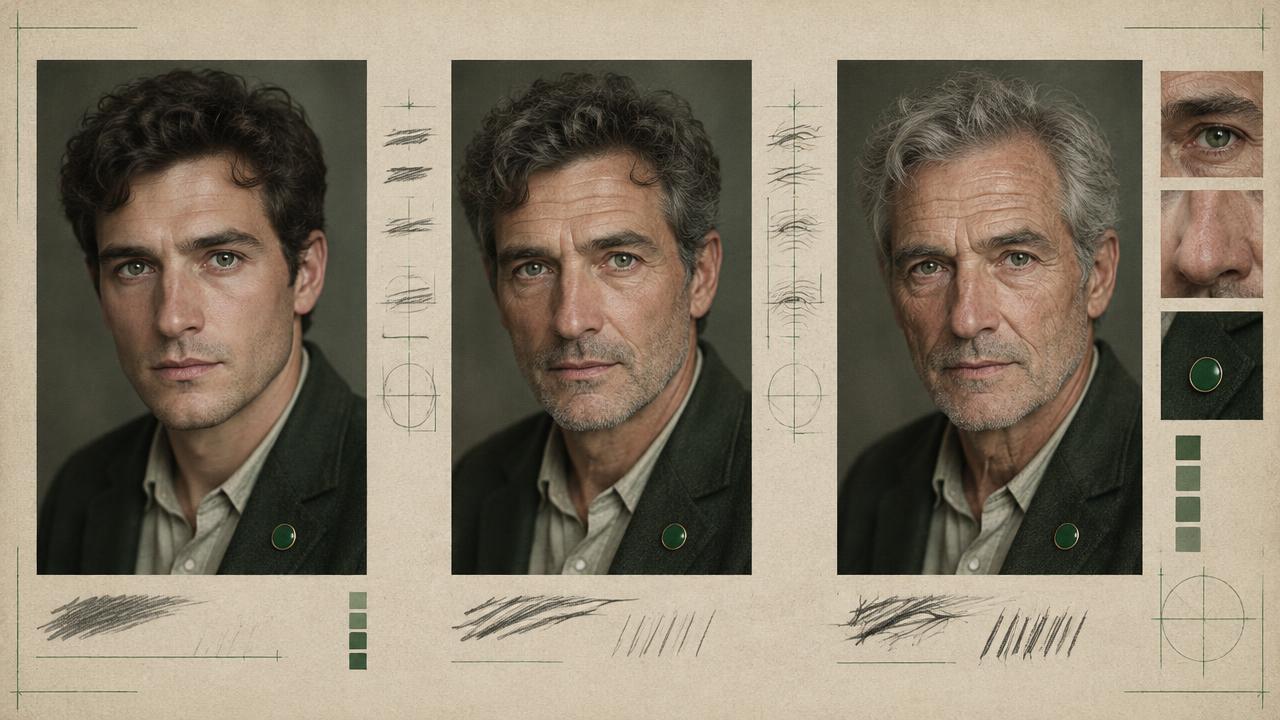
Ready-to-use prompt
The prompt
Copy it as-is, then swap the bracketed placeholders for your own details before running it.
Role: You are a continuity and makeup supervisor planning an aging progression for AI video.

Context:
- Character lock: {{character_block}}
- Start age: {{start_age}}
- End age: {{end_age}}
- Number of stages: {{stage_count}}

Task: Build an aging progression that keeps identity intact. Provide:
1. INVARIANTS, the features that never change (bone structure, eye shape and colour, ear shape, distinguishing marks)
2. Per-stage changes to skin (lines, texture, tone), hair (colour, density, style) and build
3. Wardrobe and grooming evolution appropriate to each stage
4. Posture and movement changes
5. A per-stage prompt block combining invariants with stage changes

Rules:
- Invariants are repeated verbatim in every stage.
- Age changes must be gradual between adjacent stages.
- Distinguishing marks persist and may only fade, never vanish.

Output: an invariants block plus one prompt block per stage.
Estimated results
Editor's note
Why this prompt matters
Aging a character is the sharpest test of a continuity system, because everything on the surface has to change while the person underneath stays the same. Models handle this badly by default: ask for the same character at sixty and you usually get an unrelated older person. The discipline that works is borrowed from prosthetics and makeup, which is to separate invariants from variables. Bone structure, eye shape and distinguishing marks never move. Skin, hair, build and posture carry the years. This prompt writes both lists and assembles a prompt block per stage.
Why this matters: This technique depends on permanent identity anchors and gradual age-stage variables. A visually attractive take can still fail continuity or editability when those cues disagree. Establish one controlled reference, vary one element at a time, and compare every result against the same anchors before adding more motion or styling.
Anatomy
Prompt engineering breakdown
Role
Continuity and direction role priming
Context
Age a character across years while keeping the bone structure and identity markers recognisable.
Goal
Age a character while preserving recognisable identity.
Constraints
Locked, repeated wording and explicit continuity rules replace subjective description.
Output format
invariants block plus per-stage prompt blocks
Why this structure works
An explicit invariants list gives the model the recognition anchors that survive aging, and repeating them verbatim in every stage prevents identity drift. Restricting change to skin, hair, build and posture matches how age actually presents. Gradual, staged progression keeps adjacent stages close enough that the audience reads them as one person over time.
What you'll get
Expected output
INVARIANTS: oval face, high cheekbones, wide-set hazel eyes, narrow nose with rounded tip, crescent scar above the left eyebrow.
Stage 1, age 28: smooth skin, black hair, upright posture, olive canvas jacket. Stage 2, age 45: faint forehead lines, crow feet at the outer eyes, few grey strands at the temples, slightly heavier build, tailored coat. Stage 3, age 65: deeper nasolabial lines, thinner skin with visible texture, mostly silver hair worn shorter, slight forward shoulder posture, scar faded but present.
Under the hood
Why this prompt works
An explicit invariants list gives the model the recognition anchors that survive aging, and repeating them verbatim in every stage prevents identity drift. Restricting change to skin, hair, build and posture matches how age actually presents. Gradual, staged progression keeps adjacent stages close enough that the audience reads them as one person over time.
A practical review should separate subject accuracy, motion, camera, and environment rather than judging the clip as one impression. Extreme age language can overpower identity and replace the person with a generic older face. Approve moderate adjacent stages while keeping bone structure, eye geometry, and distinguishing marks unchanged.
Review test: Compare neighbouring stages under the same crop and light; recognition should survive when hair colour and skin texture are ignored.
Production check: Treat each age as a neighbouring production stage, not a new casting choice. Preserve recognisable asymmetries and distinguishing marks, and avoid adding every age cue at once; gradual changes are easier to compare and correct.
Retain at least one unchanged wardrobe or framing cue during age approval. It gives reviewers a stable comparison point and prevents setting changes from being mistaken for successful ageing.
Model fit
Best AI models for this prompt
Veo
Use natural-language cinematography to direct permanent identity anchors and gradual age-stage variables. Veo works best when physical cause, scene response, and camera intent form one coherent description; treat numeric settings as visual cues rather than guaranteed literal controls.
Kling
Use Subject Binding or the Element Library for recurring subjects, then direct permanent identity anchors and gradual age-stage variables. Place the bound identity before style and action. Kling can produce expressive motion, so reduce simultaneous changes when consistency weakens.
Runway
Use Gen-4 References to lock the approved subject or composition, then prompt primarily for permanent identity anchors and gradual age-stage variables. Generate difficult actions as separate short clips and assemble them in an editor when exact timing or continuity matters.
When to use
- For life-story films, documentaries and brand narratives.
- For before and after storytelling.
- For flashback and flash-forward sequences.
When not to use
- For single-timeline sequences.
- For short-form content with no narrative span.
- When the character must look identical throughout.
Get more from it
Pro tips
- 1
Never let bone structure or eye shape change between stages.
- 2
Fade marks rather than removing them.
- 3
Use no more than a twenty year gap between adjacent stages.
- 4
Generate all stages before committing, then compare them side by side.
- 5
Review one controlled take for permanent identity anchors and gradual age-stage variables before increasing complexity.
Don't ship this
Common mistakes
✗ Changing face shape along with age.
Fix — Keep bone structure in the invariants and repeat it verbatim.
✗ Removing scars or freckles in later stages.
Fix — Allow marks to fade but keep them present and described.
✗ Jumping forty years in one stage.
Fix — Add intermediate stages so the progression reads as one person.
✗ Extreme age language can overpower identity and replace the person with a generic older face.
Fix — Approve moderate adjacent stages while keeping bone structure, eye geometry, and distinguishing marks unchanged.
People also ask
Frequently asked questions
Q.Why does my older character look like someone else?
Bone structure and eye shape probably changed. Put them in an invariants list and repeat it in every stage.
Q.How many stages should I use?
One stage per fifteen to twenty years of story time keeps the progression readable.
Q.Should scars stay visible?
Yes, faded but present. They are your strongest recognition anchor across a time jump.